

As the final quarter of the year approaches, many organizations begin budgeting exercises, strategic planning sessions, and operational reviews. Unfortunately, technology reviews are frequently limited to discussions about software renewals, hardware replacements, or next year’s cybersecurity spending.
The most successful organizations take a different approach.
Instead of asking, “What technology do we need to buy next year?” they ask, “Is our technology strategy still aligned with where the business is going?”
This distinction matters because technology is no longer just a support function. It influences customer experience, employee productivity, operational efficiency, regulatory compliance, business resilience, and strategic growth. Organizations that regularly revisit their technology strategy are better positioned to capitalize on opportunities while avoiding the cycle of constant crisis management.
In our previous article, Why an Evolving IT Strategy Is the Difference Between Progress and Perpetual Firefighting, we explored how organizations become trapped in reactive IT management and why technology strategies must evolve alongside business priorities.
Fall is an ideal time to put that concept into practice through a formal IT Strategy Review that evaluates whether technology investments, security initiatives, infrastructure decisions, and business objectives remain aligned.
Before finalizing budgets and initiatives for the coming year, leadership teams should conduct a comprehensive IT Strategy Review that evaluates not only infrastructure and security, but also governance, business processes, application portfolios, staffing models, and long-term strategic alignment.
An effective IT Strategy Review helps leadership identify risks, prioritize investments, and create a technology roadmap that supports measurable business outcomes.
Below are the key areas every leadership team should evaluate now.
Start Your IT Strategy Review with Business Objectives
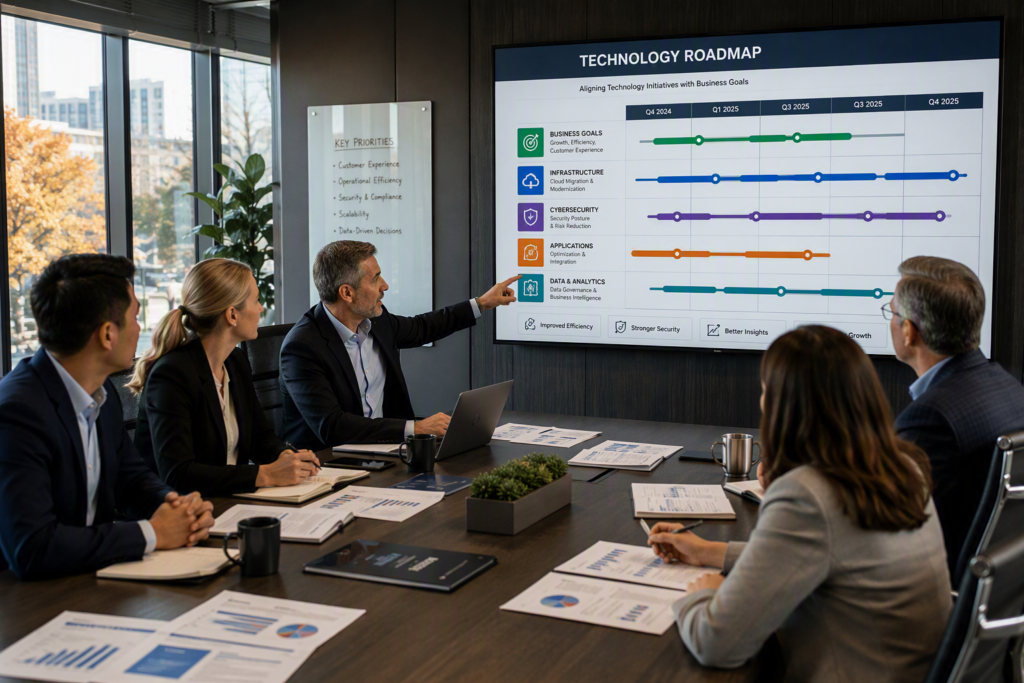
One of the most common mistakes organizations make is reviewing technology independently from business strategy.
The business should lead technology decisions, not the other way around.
Before discussing software upgrades, cybersecurity projects, or infrastructure investments, leadership should answer several key questions:
- What are our primary growth goals for next year?
- What operational challenges are slowing progress?
- Which customer experiences need improvement?
- Are we entering new markets or expanding services?
- Are regulatory requirements changing?
- What business risks concern leadership most?
Only after identifying organizational priorities should technology reviews begin.
This ensures investments directly support measurable business outcomes rather than simply modernizing systems for the sake of modernization.
At Sound Power Solutions, this philosophy forms the foundation of our Virtual CIO Services, helping organizations align technology investments with broader business objectives rather than treating IT as an isolated operational function.
IT Strategy Review: Is Your Technology Strategy Still Aligned?
A technology strategy that was effective eighteen months ago may no longer fit today’s business environment.
Consider how much may have changed:
- New service offerings
- Growth in workforce size
- Increased remote work
- AI adoption opportunities
- Mergers or acquisitions
- New compliance requirements
- Evolving cybersecurity threats
Many organizations continue operating under assumptions that are no longer valid.
The purpose of an IT Strategy Review is not simply to examine technology assets. It is to determine whether technology is actively supporting organizational goals.
Leadership should assess:
Strategic Alignment
Does technology still support current business priorities?
Scalability
Can existing systems support projected growth?
Agility
Can the organization quickly adapt to new opportunities or operational changes?
Risk Tolerance
Are technology controls still aligned with current business risks?
An annual IT Strategy Review helps identify where strategy adjustments may be needed before operational issues become significant business obstacles.
Assess Cybersecurity Readiness Beyond Compliance
Cybersecurity remains one of the most important leadership discussions entering any new fiscal year.
However, the conversation must extend beyond simply checking compliance boxes.
The cybersecurity landscape continues to evolve rapidly. According to the Cybersecurity and Infrastructure Security Agency (CISA), organizations should take a risk-based approach that prioritizes operational resilience, threat mitigation, and continuous improvement rather than relying solely on periodic assessments.
Every comprehensive IT Strategy Review should include a detailed cybersecurity risk assessment.
Leadership teams should evaluate:
Identity Security

- Multi-factor authentication deployment
- Privileged account management
- Conditional access policies
- User access reviews
Endpoint Security
- Device management policies
- Patch management effectiveness
- Antivirus and EDR coverage
Data Protection
- Backup validation
- Retention policies
- Data classification
- Encryption practices
Incident Response
- Response plans
- Recovery procedures
- Communication protocols
- Cyber insurance alignment
Security Awareness
Technology alone cannot stop phishing attacks or social engineering efforts.
Employee training should remain a key component of cybersecurity planning.
Technology leaders should also verify that cybersecurity investments are directly tied to business risk reduction rather than being driven exclusively by vendor recommendations.
IT Strategy Review Opportunity: Maximizing Microsoft 365 Investments
Many organizations invest heavily in Microsoft 365 yet only use a fraction of its available capabilities.
A fall IT Strategy Review should examine whether the organization is maximizing value from existing licensing.
Areas to evaluate include:
- Microsoft Teams utilization
- SharePoint governance
- OneDrive storage practices
- Power Automate opportunities
- Power BI adoption
- Microsoft Purview capabilities
- Security and compliance settings
- License optimization
Organizations frequently discover they are paying for solutions already included within their Microsoft ecosystem.
A strategic review can help eliminate duplicate software costs while improving user productivity.
Sound Power Solutions regularly assists organizations through our Microsoft 365 Support Services, helping teams improve collaboration, governance, security, and overall return on investment.
Examine Technical Debt Across Systems
Technical debt rarely appears in financial statements, but it can have a significant impact on productivity, security, and operational efficiency.
Examples include:
- Unsupported software
- Legacy databases
- Aging servers
- Manual workflows
- Poor system integrations
- Outdated custom applications
Technical debt often accumulates gradually as organizations prioritize short-term needs over long-term modernization.
Technical debt is one of the most commonly overlooked findings during an IT Strategy Review.
Leadership should ask:
- Which systems create excessive support effort?
- Which applications are difficult to update?
- Are critical business processes dependent on single individuals?
- Which systems pose security risks?
- Which technologies limit future growth?
Addressing technical debt strategically prevents organizations from facing costly emergency replacements later.
Evaluate Business Process Efficiency
Technology should support efficient operations.
If employees continue relying on spreadsheets, repetitive data entry, or disconnected processes, technology may be contributing to inefficiency rather than solving it.
Leaders should identify processes that:
- Require duplicate data entry
- Depend on paper approvals
- Create reporting delays
- Produce frequent errors
- Limit visibility into operations
Modern automation tools provide substantial opportunities for improvement.
The Microsoft Power Platform and other workflow technologies have enabled organizations to automate repetitive processes while reducing operational costs and improving consistency.
Rather than simply adding new software, organizations should examine how existing platforms can be leveraged more effectively.
This often results in measurable productivity gains without major infrastructure investments.
Review Application Portfolio Health
Most organizations accumulate applications over time.
Individual departments acquire solutions independently, resulting in:
- Overlapping functionality
- Redundant licensing
- Data silos
- Increased security exposure
- Complex support requirements
Leadership should review every major application and ask:
Is It Being Used?
Unused software continues generating cost without value.
Is It Strategic?
Some applications become mission-critical while others remain tactical.
Is It Secure?
Every application creates a potential attack surface.
Is It Integrated?
Disconnected applications reduce productivity and increase data inconsistencies.
Application rationalization is often a high-value component of an IT Strategy Review because it can uncover unnecessary costs and complexity.
Our IT Portfolio Assessment Services are specifically designed to help organizations evaluate technology investments, identify redundancies, and prioritize future improvements based on business value.
Analyze Data and Reporting Capabilities
Leadership decisions depend on accurate, timely information.
Yet many organizations continue relying on:
- Static spreadsheets
- Manual reporting
- Disconnected data sources
- Inconsistent metrics
During an IT Strategy Review, leaders should evaluate:
- How quickly key reports are produced
- Whether reporting is automated
- Data quality standards
- Dashboard utilization
- Business intelligence maturity
Organizations increasingly recognize that data is a strategic asset.
The challenge is not collecting data.
The challenge is transforming data into actionable insights.
This is an area where technology strategy, business analysis, and organizational governance intersect.
Investigate AI Readiness
Artificial intelligence has become a major leadership conversation.
However, many organizations are approaching AI from the wrong direction.
Instead of asking:
“What AI tool should we buy?”
Leadership should ask:
“Are we ready to benefit from AI?”
Successful AI initiatives require:
- Well-organized data
- Strong security controls
- Governance policies
- Documented business processes
- Change management planning
As AI adoption accelerates, the IT Strategy Review process should include evaluating governance, data quality, and organizational readiness.
Without these foundational elements, AI initiatives often deliver disappointing results.
The fall technology review provides an excellent opportunity to evaluate organizational readiness and identify improvement areas that will support future AI adoption.
IT Strategy Review Considerations for Infrastructure Resilience
Infrastructure failures can disrupt productivity, damage customer trust, and create financial losses.
Leadership should evaluate:
Business Continuity
Can critical operations continue during an outage?
Disaster Recovery
How quickly can systems be restored?
Redundancy
Are critical services protected against single points of failure?
Remote Workforce Support
Can employees remain productive from alternate locations?
Cloud Readiness
Does the infrastructure support future flexibility and scalability requirements?
Infrastructure planning should focus not only on current operations but also long-term business resilience.
Our Managed Office Infrastructure and Managed System Support Services help organizations ensure their technology environments remain reliable, secure, and capable of supporting growth.
Review Vendor and Partner Relationships
Technology vendors become critical components of modern operations.
Vendor relationships are frequently overlooked during an IT Strategy Review, despite their impact on costs, security, and operational performance.
Leadership should evaluate:
- Contract terms
- Service-level agreements
- Renewal dates
- Security obligations
- Vendor performance
- Support responsiveness
Many organizations discover they are paying for services they no longer need or working with providers whose capabilities no longer align with organizational requirements.
Strong vendor governance helps reduce costs while improving accountability.
Evaluate Staffing and Technology Leadership Needs
Technology reviews should include an honest assessment of internal capabilities.
Questions to consider include:
- Does the organization have sufficient technical expertise?
- Are key responsibilities concentrated with a single employee?
- Is leadership receiving strategic technology guidance?
- Are employees receiving adequate training?
- Are succession plans in place?
An annual IT Strategy Review should also evaluate whether current staffing models can support future technology objectives.
Growing organizations frequently outgrow their original IT operating model.
They may require expanded governance, improved project management, additional security expertise, or executive-level strategic technology leadership.
This is one reason many organizations leverage Virtual CIO Services, gaining access to experienced technology leadership without the cost of a full-time CIO.
Identify Opportunities for Modernization and Integration
Disconnected systems create friction throughout the organization.

Employees often compensate through:
- Manual exports
- Duplicate data entry
- Custom spreadsheets
- Email-driven processes
Modern integration approaches can significantly improve operational efficiency.
Leaders should identify opportunities to:
- Connect business platforms
- Streamline information flow
- Improve customer experiences
- Eliminate repetitive tasks
- Increase reporting accuracy
Sound Power Solutions’ Systems & Software Development Services and System Integration Services help organizations bridge technology gaps, connect disparate systems, and develop solutions tailored to operational requirements.
A modernization initiative does not necessarily require replacing existing systems. Frequently, integration and automation provide substantial improvements while preserving prior technology investments.
Conduct an IT Compliance Review
Regulatory requirements continue evolving across industries.
Depending upon organizational needs, reviews may involve:
- Data privacy requirements
- Financial controls
- Security frameworks
- Industry-specific regulations
- Internal governance standards
The National Institute of Standards and Technology (NIST) recommends continuous assessment and improvement as a core component of cybersecurity and risk management programs. Organizations that regularly evaluate controls are better positioned to identify gaps before they become compliance issues.
A proactive compliance review often costs significantly less than remediating deficiencies following an audit or security incident.
Sound Power Solutions offers IT Compliance Reviews to help organizations better understand technology risks, governance needs, and compliance obligations.
For additional guidance, organizations can review the NIST Cybersecurity Framework: https://www.nist.gov/cyberframework
Turning Your Annual IT Strategy Review into a Competitive Advantage
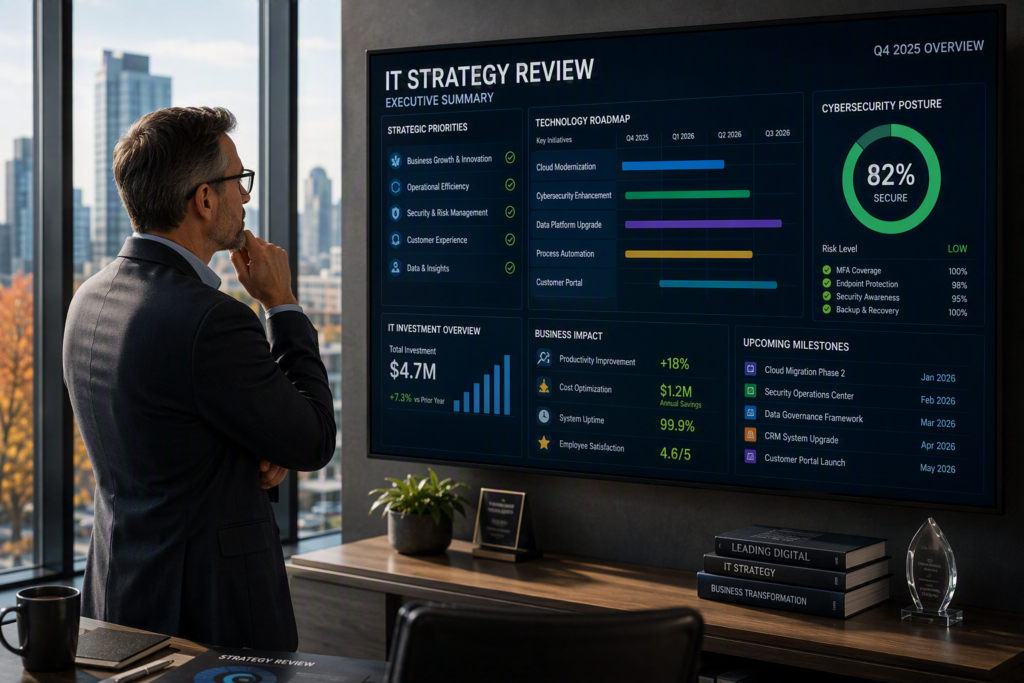
Technology reviews should not be viewed as an annual administrative exercise.
They are strategic planning opportunities.
Organizations that conduct an annual IT Strategy Review are typically better equipped to:
- Improve productivity
- Strengthen cybersecurity
- Reduce operational risk
- Control costs
- Increase scalability
- Enable innovation
- Support growth initiatives
Most importantly, they avoid the reactive cycle described in our earlier article, Why an Evolving IT Strategy Is the Difference Between Progress and Perpetual Firefighting.
When technology strategy evolves alongside business priorities, organizations spend less time responding to emergencies and more time creating measurable value.
Rather than viewing the IT Strategy Review as a budgeting exercise, leadership teams should treat it as a strategic planning activity that supports growth, security, productivity, and innovation.
As you prepare budgets and priorities for the coming year, use this fall review as an opportunity to look beyond software renewals and hardware refreshes. Evaluate the broader technology ecosystem, assess organizational readiness, and ensure technology investments are helping move the business forward.
At Sound Power Solutions, our team helps organizations align technology strategy with business outcomes through Virtual CIO Services, Managed IT Support, Microsoft 365 Support, IT Portfolio Assessments, IT Compliance Reviews, System Integration Services, and Custom Software Development Services. Whether you need a comprehensive technology assessment or guidance building a long-term roadmap, we can help you transform technology from a source of operational friction into a strategic advantage.
Ready to begin your annual IT Strategy Review?
Contact Sound Power Solutions to schedule a technology assessment and uncover opportunities to improve security, efficiency, scalability, and business performance before the next planning cycle begins.