
In many organizations, IT is seen in one of two ways. In the best cases, it’s a predictable, efficient engine that quietly enables growth, innovation, and reliability. In the worst cases, it’s a frantic group of talented people spending their days reacting to outages, incidents, and “urgent” requests that derail any sense of long-term progress.
The difference between these two realities rarely comes down to talent or effort. More often than not, it comes down to strategy—and whether that strategy is treated as a living, evolving discipline or a static document that slowly becomes obsolete.
Strategy Is Not a One-Time Exercise
An IT strategy that is written once and shelved is not a strategy; it’s a snapshot of a moment in time. Technology, business priorities, security threats, and customer expectations evolve far too quickly for that approach to succeed.
An effective IT strategy must evolve continuously alongside the organization it supports. As business goals shift, markets change, and new technologies emerge, IT must reassess its priorities, architectures, and operating models. This doesn’t mean constant chaos or reinvention; it means deliberate, thoughtful adjustment.
Organizations that understand this treat IT strategy as a cycle:
- Assess current capabilities and pain points
- Align with evolving business objectives
- Prioritize investments and initiatives
- Execute, measure, and learn
- Repeat
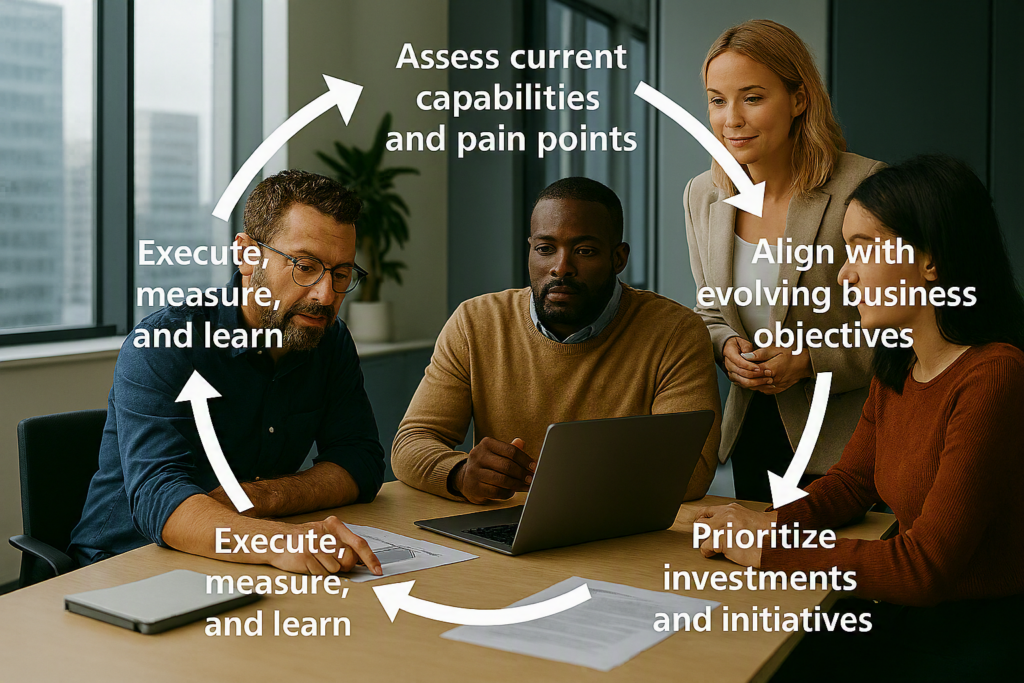
This ongoing loop is what keeps IT relevant, resilient, and aligned.
The Cost of Standing Still
When IT strategy fails to evolve, the consequences are predictable. Systems grow brittle. Technical debt accumulates silently. Security gaps widen. Tools are layered on without integration or clear ownership. Eventually, small issues compound into outages, performance problems, and user frustration.
At this point, IT teams are no longer steering the organization; they’re reacting to it.
Firefighting becomes the norm:
- Projects are delayed or abandoned due to “urgent” incidents
- Staff burn out from constant context switching
- Root causes are rarely addressed, only patched
- Trust between IT and the business erodes
Ironically, teams in this mode are often working harder than ever—but producing less strategic value.
Predictability Enables Progress
In contrast, organizations with an evolving IT strategy experience a very different dynamic. Their IT departments are not immune to problems—no environment ever is—but issues are anticipated, planned for, and resolved within a known framework.

This predictability creates space for:
- Proactive maintenance instead of reactive fixes
- Road mapped upgrades instead of emergency replacements
- Capacity planning instead of last-minute scrambling
- Security by design instead of crisis response
Most importantly, it allows IT to contribute consistently to organizational goals rather than constantly pulling attention away from them.
Alignment Turns IT Into a Business Partner
An evolving strategy ensures that IT decisions are driven by business outcomes, not just technical preferences. When IT leaders regularly revisit strategy in collaboration with business stakeholders, technology choices are made with intent and context.
This shifts the perception of IT from a cost center to a strategic partner:
- Technology initiatives are clearly tied to business value
- Tradeoffs are understood and communicated
- Investments are prioritized based on impact, risk, and timing
In these environments, IT helps shape what’s possible instead of being blamed for what went wrong.
Evolution Does Not Mean Instability
It’s important to be clear: an evolving IT strategy does not mean constant disruption. In fact, the opposite is usually true. Organizations that plan for change are far more stable than those that resist it.
By regularly adjusting strategy, IT teams can introduce change incrementally, intentionally, and with clear communication. This reduces surprises and builds organizational confidence in IT’s ability to manage complexity.
Evolution, when done well, creates stability—not chaos.
The Choice Is Ongoing
Every organization faces a choice. IT can operate as a reactive function, defined by the latest emergency and the loudest complaint. Or it can operate as a disciplined, forward-looking contributor to success, guided by a strategy that evolves with the realities of the business.

The difference is not luck. It’s intent.
An evolving IT strategy doesn’t eliminate problems—but it ensures they don’t define the organization. And in today’s environment, that can be the difference between treading water and moving forward with confidence.
A Real-World Example: From Firefighting to Forward Momentum
Consider a mid-sized organization that had grown steadily over a decade. Their IT environment had grown with them—but without a clear, evolving strategy behind it. Each major business initiative brought a new system, a new vendor, or a new workaround. Nothing was necessarily “wrong” on any given day, but everything felt fragile.
The IT team spent most mornings reacting:
- Storage alerts that should have been addressed months earlier
- Servers nearing end-of-life with no replacement plan
- Applications critical to operations supported by a single person’s tribal knowledge
- Security patches delayed because “now isn’t a good time”
Every outage was treated as an isolated incident, even though the same themes kept resurfacing. Leadership perceived IT as overworked but unreliable. The team felt burned out and defensive, constantly explaining why they couldn’t “just fix it.”
The turning point came when the organization made a deliberate shift: instead of asking IT to simply solve the next problem, they asked IT to define where things were headed.
The IT leadership team stepped back and established a living strategy—not a massive binder, but a clear set of principles, priorities, and upcoming decisions aligned to business goals. They reviewed infrastructure maturity, application lifecycles, skills gaps, and risk exposure. Just as importantly, they committed to revisiting this strategy regularly as conditions changed.
The results were not instant, but they were noticeable.
Within months:
- Aging systems were identified and placed on a phased replacement roadmap instead of waiting for failure
- Repeated incidents led to root-cause fixes rather than recurring tickets
- Projects were prioritized based on business impact, not volume of requests
- Leadership had fewer surprises and clearer expectations
Over time, IT shifted from being seen as “the team that fixes things when they break” to “the team that plans ahead and keeps things running.” Incidents still happened—because they always do—but they no longer defined the department’s identity.
The difference wasn’t more people, more budget, or better tools. It was an IT strategy that evolved as the organization evolved, turning chaos into clarity and reaction into intention.