
Hybrid work didn’t make the office irrelevant.
It made the office optional.
And when something becomes optional, you don’t win with policies. You win with pull—with a clear, compelling reason to choose it.
That’s the shift leaders are still catching up to: the goal is no longer getting people back. The goal is making the office worth it.
Because people don’t commute for a chair and a monitor. They commute for connection.
The commute needs a payoff
If an “in-office day” is just eight hours of video calls in a different location, people will notice. And they’ll quietly decide it’s not worth repeating.
In hybrid, the office can’t be a backdrop. It has to be a multiplier.
The question isn’t: “How often should people be here?”
The question is: “What happens here that can’t happen anywhere else?”
When you answer that clearly, the rest gets easier:
- Teams coordinate intentionally instead of colliding randomly.
- New hires build relationships faster.
- Decisions compress from weeks to hours.
- Culture stops being something you “talk about” and becomes something you experience.
Stop managing attendance. Start designing the experience.
A lot of organizations are still stuck in an old mental model:
- Presence = commitment
- Visibility = performance
- Seats filled = success
That model worked (or at least looked like it worked) when the office was the default.
In hybrid, it backfires.
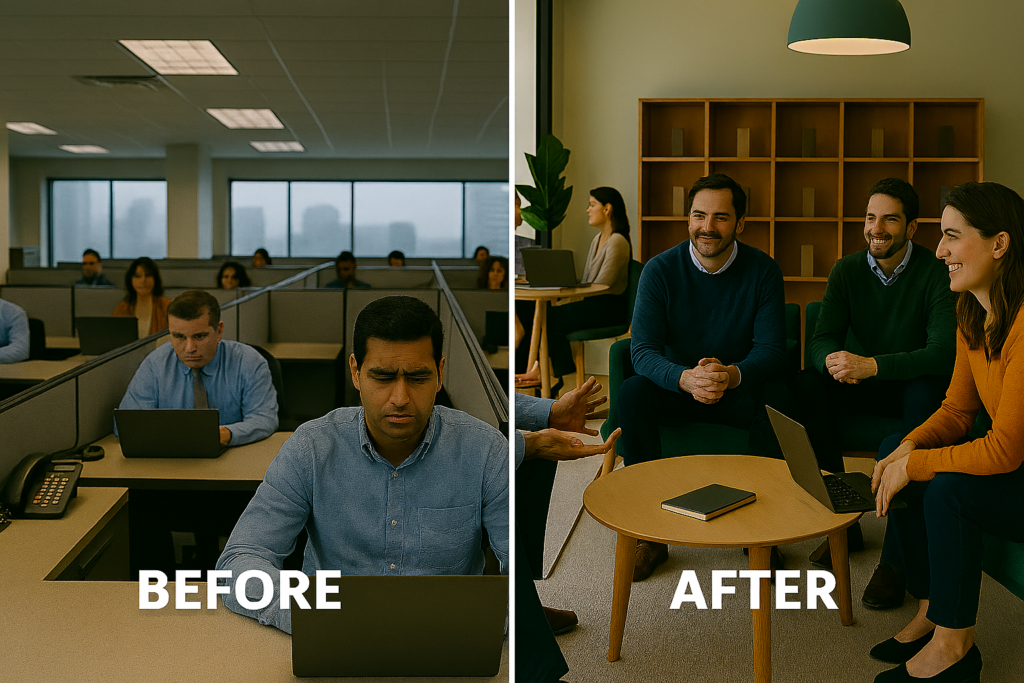
Because if you lead with attendance, you force people into the building without improving the work. That creates the most expensive kind of dissatisfaction: “I came in and got less done.”
So shift the KPI:
- From occupancy to outcomes
- From mandates to moments
- From space to experience
A destination office isn’t measured by badge swipes. It’s measured by what gets better because people were together.
Program the office like you mean it
Space alone doesn’t create value. Intent does.
That’s where most hybrid offices fail: they provide a place to sit, but they don’t provide a reason to show up.
Think of it this way:
A gym with no classes might still be a gym… but it’s not a community.
An office with no programming might still be an office… but it’s not a destination.
So program it.
Not with forced fun. With high-value moments that are easier, faster, or better in person.
Here are the three anchors that consistently work:
1) Team days (alignment on purpose)
Team days shouldn’t be “come in and do your normal work.”
Team days should be designed around the things that benefit from shared energy:

- planning and prioritization
- whiteboarding and problem-solving
- retrospectives and working agreements
- cross-functional alignment
- roadmap reviews and decision-making
The goal is simple: leave with clarity.
If people walk out with better alignment than they had walking in, they’ll come back.
2) Workshops (replace meeting sprawl with decisions)
Hybrid tends to create meeting inflation. Everything becomes a call. Everything becomes recurring. Everything drifts.
Workshops are the antidote.
Instead of five one-hour meetings that don’t land anywhere, you run one focused session that ends with:
- a decision
- an owner
- a next step
Workshops turn the office into what it should be: a place where ambiguity gets resolved faster.
3) Onboarding (turn culture into something you can feel)
Hybrid onboarding often turns into “here’s a laptop, good luck, see you on Zoom.”
That’s not onboarding. That’s provisioning.
New hires don’t just need information. They need:
- context
- relationships
- informal learning
- psychological safety to ask questions
When the office becomes a destination, onboarding becomes an accelerator:
- cohort-based first weeks
- meet-the-team rotations
- shadowing
- structured introductions beyond the immediate team
- intentional culture moments (not just slide decks)
If you want culture to scale in hybrid, don’t rely on osmosis. Design the early experience.
Social capital is the real return on office time
Here’s the part that’s easy to miss because it doesn’t show up in a calendar invite:
The office’s biggest value isn’t scheduled meetings.
It’s the unscheduled interactions that build trust, speed, and innovation.
Social capital is what makes execution smoother:
- you know who to ask
- you feel comfortable reaching out
- you interpret tone correctly
- you give benefit of the doubt
- you solve problems earlier, before they become escalations
In a fully distributed environment, social capital can decay quietly. And when it does, you start seeing symptoms:
- more misunderstandings
- slower decisions
- duplicated work
- higher “coordination tax”
- more “why didn’t anyone tell me?”
A destination office rebuilds social capital by creating the conditions for:

- spontaneous conversation
- cross-team visibility
- quick clarifications
- informal mentoring
- “weak tie” connections that spark new ideas
Innovation doesn’t happen only in brainstorm sessions.
It often happens when someone says, “Wait—our team solved something like that last quarter.”
Those moments require proximity. Or at least… they require designed collision.
Design with hospitality, not just efficiency
Most offices were built for a world where people had to be there.
Hybrid offices need to be built for a world where people choose to be there.
That’s why the best workplace strategy right now isn’t “more desks.” It’s hospitality.
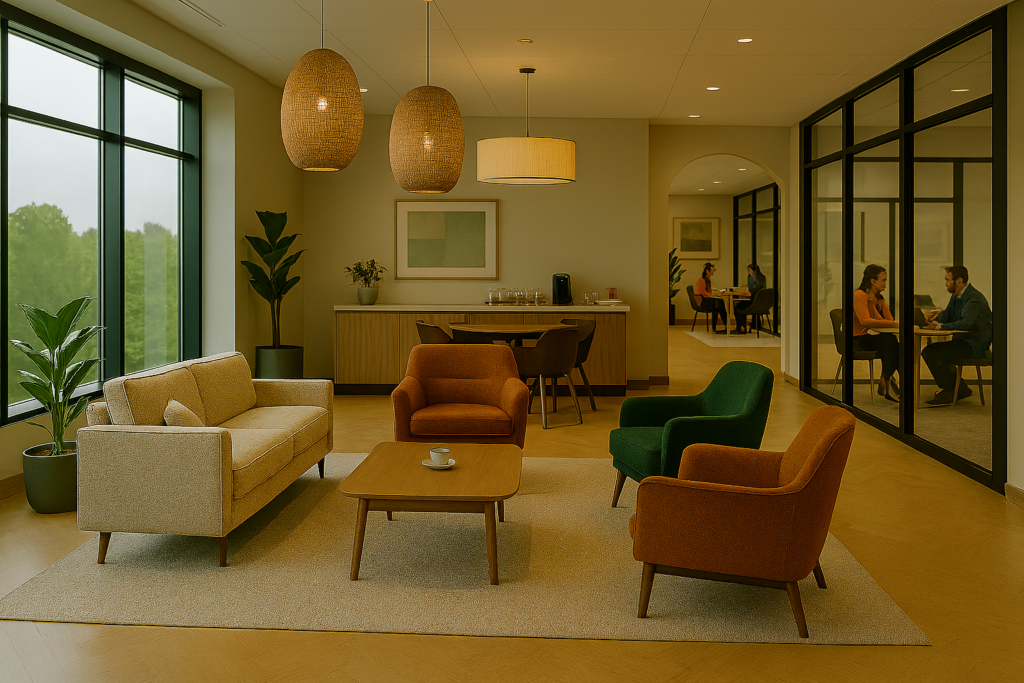
Hospitality design asks:
- Is the experience welcoming?
- Is it easy to navigate?
- Does it reduce friction?
- Do people feel taken care of?
- Is it comfortable enough to stay and connect?
This doesn’t mean ping-pong tables and kombucha taps.
It means getting the fundamentals right:
Make arrival feel intentional
First impressions matter. If the first ten minutes are annoying—parking, entry, wayfinding, nowhere to land—people start the day irritated.
Destination offices remove that friction.
Offer a menu of spaces
People don’t work in one mode all day. Neither should the office.
A destination office supports:
- focus (quiet zones, booths)
- collaboration (project rooms, writable walls)
- quick connection (huddle spaces)
- 1:1s (comfortable, semi-private seating)
- community (lounges, café-style areas)
Make hybrid meetings not miserable
If remote participants feel like second-class citizens, the office becomes divisive.
Invest in the basics:
- reliable audio
- cameras that capture faces (not ceilings)
- layouts that include remote attendees by default
- norms that prevent side conversations from hijacking the room
The goal is equity of participation—not just “having the tech.”
Treat amenities as friction reducers
Good coffee isn’t a perk. It’s a signal.
Comfortable seating isn’t indulgent. It’s what makes people stay long enough to talk.
Small details—lighting, acoustics, temperature consistency—decide whether people want to be there again.
A simple way to start (without renovating)
You don’t need a major rebuild to shift the office into a destination. You need clarity and repetition.
Here’s a practical starting sequence:
1. Define the office “job.”
One sentence. No fluff.
Example: “The office is where we align, onboard, and collaborate.”
2. Create two anchor rhythms.
- Team days (per team cadence)
- One monthly all-hands / demo / workshop day
3. Design the day, not just the space.
Publish a lightweight template:
- what we do in person
- what we don’t do in person
- how we include remote participants when needed
4. Remove the friction people complain about.
If booking rooms is painful, fix it.
If audio is unreliable, fix it.
If there’s nowhere to take a call, fix it.
Then watch what changes: not in attendance first—but in energy, collaboration, and speed.
The takeaway for hybrid work
People don’t come to the office for desks—they come for connection.
The office becomes a destination when it provides something rare in modern work:
- momentum
- belonging
- trust
- shared context
- real collaboration without friction
If you want people to choose to come in, don’t ask for compliance.
Design the experience so the commute makes sense.