
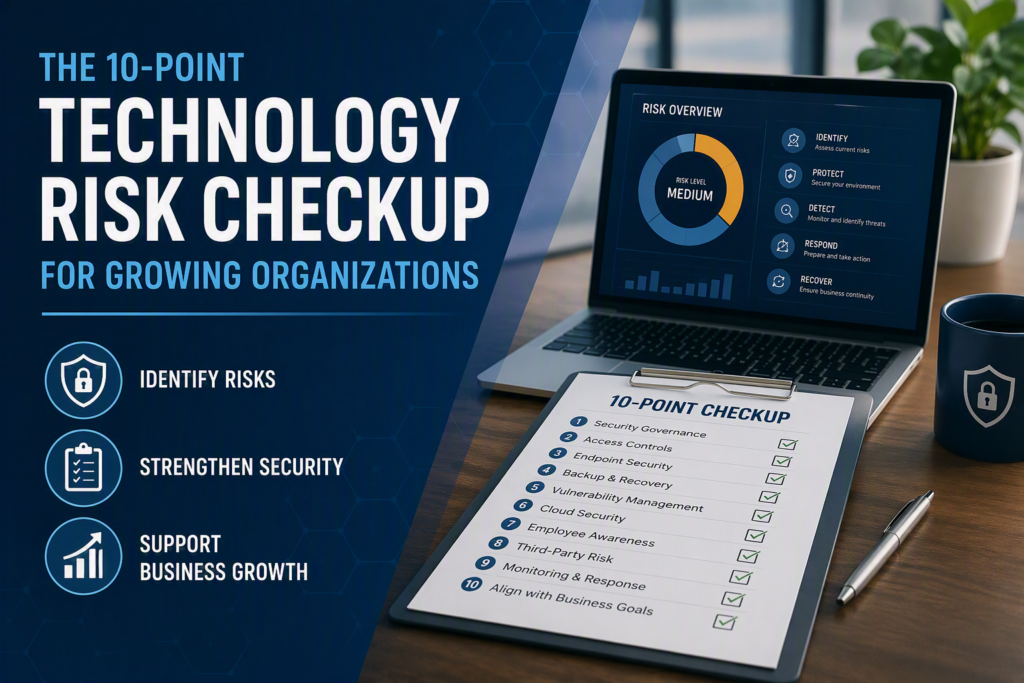
As organizations grow, their technology environments become more complex. New employees join the team, cloud platforms expand, business applications multiply, and critical data moves across more systems than ever before. Growth is exciting, but it also introduces new risks that can quietly accumulate until they become costly disruptions.
Many business leaders assume cybersecurity is purely an IT concern. In reality, technology risk affects every aspect of an organization, from customer trust and employee productivity to regulatory compliance and operational continuity. A single security incident can result in downtime, financial loss, reputational damage, and significant recovery costs.
In our recent article, How Can You Strengthen Your Cybersecurity Strategy by 2026?, we discussed the importance of taking a proactive approach to security rather than waiting for a breach or compliance failure to force action. One practical way to put that strategy into motion is by conducting a regular technology risk checkup.
Think of a technology risk checkup as an annual physical for your organization’s technology environment. It helps identify vulnerabilities, gaps, and emerging risks before they impact operations. Whether you have an internal IT department, outsourced IT services, or a hybrid model, a structured review can reveal important opportunities to improve security, resilience, and efficiency.
Why a Technology Risk Checkup Matters More Than Ever
Technology risk is no longer a concern reserved for large enterprises with dedicated security teams. Organizations of every size face a growing range of threats, including ransomware, credential theft, business email compromise, supply chain attacks, and cloud security misconfigurations.
The challenge is not simply that threats are increasing. It is that technology environments are becoming more interconnected and complex. Businesses rely on software vendors, cloud providers, remote workers, mobile devices, and third-party partners to operate efficiently. Each connection creates new opportunities for growth, but also introduces additional risk.
According to the 2025 Data Breach Investigations Report from Verizon, third-party involvement continues to play a significant role in security incidents, highlighting the growing importance of understanding not only your own security posture but the risks introduced by vendors and business partners. The report analyzed more than 22,000 real-world security incidents and more than 12,000 confirmed breaches worldwide.
The National Institute of Standards and Technology (NIST) similarly emphasizes that cybersecurity risk management should be integrated into broader business risk management practices. Their guidance recognizes that cybersecurity is no longer purely a technical issue. It directly impacts financial performance, reputation, operations, compliance obligations, and organizational resilience.
This is why a regular technology risk checkup is so valuable. It provides a structured way to identify gaps, prioritize improvements, and ensure technology investments support both security objectives and business goals.
1. Evaluate Your Security Governance and Policies
Technology risk management begins with governance. Even organizations with strong technical controls can struggle if they lack clear policies, procedures, and accountability.
Ask yourself:
- Do we have documented security policies?
- Are responsibilities clearly defined?
- How often are policies reviewed and updated?
- Do employees understand their role in protecting company information?
Technology environments change rapidly. Policies created several years ago may no longer reflect current threats, cloud platforms, remote work practices, or regulatory requirements.
Organizations should establish:
- Information security policies
- Acceptable use policies
- Incident response procedures
- Data handling standards
- Vendor security requirements
- Business continuity plans
Strong governance creates consistency and provides a foundation for all other security initiatives.
2. Review Access Controls and User Permissions
One of the most common causes of security incidents is excessive access.
As organizations grow, employees change roles, departments expand, and new systems are introduced. Over time, users often accumulate permissions they no longer need.
A technology risk checkup should examine:
- User account management
- Privileged administrator access
- Shared accounts
- Former employee accounts
- Third-party vendor access
- Multi-factor authentication adoption
The principle of least privilege remains one of the most effective security strategies available. Employees should have access only to the systems and data necessary to perform their jobs.
Particular attention should be given to administrative accounts, service accounts, and remote access systems.
Recommended Action
Conduct quarterly access reviews and require multi-factor authentication for all critical systems.
For organizations lacking dedicated security resources, consider leveraging professional Managed IT and Security Services to ensure permissions, identity management, and access controls are consistently monitored and maintained.
3. Assess Endpoint Security
Every laptop, desktop, smartphone, and tablet connected to your network represents a potential entry point for attackers.

Today’s cybercriminals frequently target endpoints through:
- Phishing attacks
- Malware
- Ransomware
- Credential theft
- Social engineering
Many organizations rely solely on traditional antivirus solutions, which may not provide sufficient protection against modern threats.
Your technology risk checkup should evaluate:
- Endpoint detection and response (EDR)
- Antivirus effectiveness
- Device encryption
- Mobile device management
- Operating system patch levels
- Asset inventory accuracy
A surprising number of businesses cannot accurately identify every device connected to their environment. If you don’t know what devices exist, you cannot effectively secure them.
Organizations should maintain a current inventory of all managed and unmanaged endpoints.
4. Examine Backup and Disaster Recovery Readiness
Backups are one of the most important safeguards against ransomware and operational disruptions.
Unfortunately, many organizations discover backup problems only after a crisis occurs.
Questions to ask include:
- Are backups occurring successfully?
- How frequently are backups tested?
- Can critical systems be restored quickly?
- Are backups protected against ransomware?
- Do offsite copies exist?
A technology risk checkup should include a review of both backup systems and recovery processes.
Many organizations focus on backup completion rates but never verify restoration capabilities. A backup is only valuable if it can be recovered when needed.
Conduct regular recovery exercises to validate:
- Recovery time objectives (RTO)
- Recovery point objectives (RPO)
- Application functionality after restoration
- Staff preparedness during recovery events
Business continuity depends on much more than simply storing backup data.
5. Identify Vulnerabilities and Patch Management Gaps
Cybercriminals actively exploit known vulnerabilities. In many cases, security patches are available months before attackers strike.
One of the most effective components of a technology risk checkup is a structured vulnerability management review.
Key questions include:
- Are systems scanned regularly?
- How are vulnerabilities prioritized?
- How quickly are critical patches deployed?
- Are unsupported systems still in use?
- Do third-party applications receive updates?
Many breaches occur not because organizations lack security tools, but because existing vulnerabilities remain unaddressed.
A mature patch management program should include:
- Automated vulnerability scanning
- Risk-based prioritization
- Testing procedures
- Patch deployment schedules
- Reporting and compliance tracking
Security requires ongoing maintenance, not one-time projects.
6. Review Cloud Security Configurations
Cloud adoption continues to accelerate, but cloud security often lags behind deployment.
Microsoft 365, Azure, Google Workspace, Salesforce, and countless other cloud services contain advanced security capabilities that organizations never fully configure.
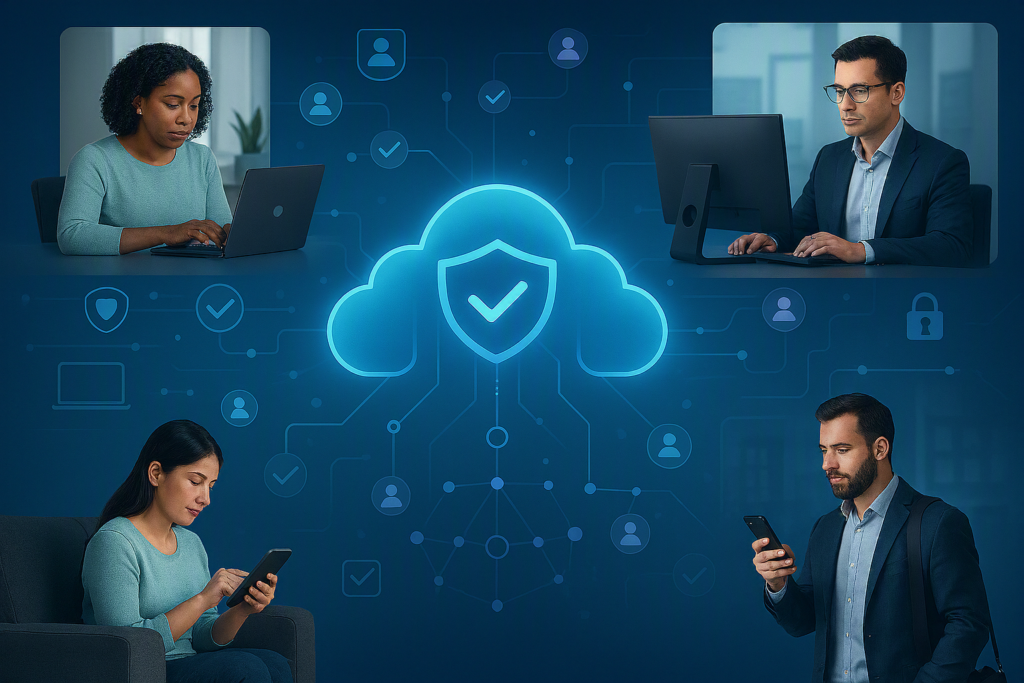
During a technology risk checkup, organizations should review:
- Identity and access management
- Conditional access policies
- Data retention settings
- Backup strategies
- Audit logging
- Security monitoring
- Data sharing controls
Cloud environments frequently contain misconfigurations that expose sensitive information unintentionally.
Examples include:
- Public file-sharing links
- Excessive permissions
- Disabled security alerts
- Weak authentication controls
- Improper retention settings
Proper cloud governance is now essential for organizations of every size.
Organizations looking to maximize the value of Microsoft 365 and Azure should ensure security configuration reviews are a routine part of their technology roadmap. If you need help getting your cloud configuration secure, you should access managed service provider options such as our M365 support services and our COTS support services.
7. Evaluate Employee Security Awareness
Technology alone cannot eliminate cyber risk.
Employees remain the primary target of phishing campaigns, business email compromise attacks, and social engineering efforts. Attackers know that tricking a person is often easier than defeating a security system.

A technology risk checkup should evaluate:
- Security awareness training programs
- Phishing simulation results
- Reporting procedures
- Password practices
- Remote work security habits
Training should not be a once-a-year exercise.
Organizations benefit from ongoing education that addresses:
- Emerging threats
- Phishing recognition
- Secure data handling
- Remote work security
- Artificial intelligence risks
- Social engineering tactics
Creating a security-aware culture can dramatically reduce risk exposure.
8. Analyze Third-Party Vendor Risk
Vendors, consultants, managed service providers, SaaS platforms, and business partners often have access to critical systems and sensitive information.
As organizations grow, their vendor ecosystem becomes increasingly complex.
Unfortunately, third-party relationships can introduce significant risk.
Your technology risk checkup should answer:
- Which vendors access sensitive data?
- What security requirements exist?
- Are contracts reviewed regularly?
- How are vendors monitored?
- What happens if a vendor experiences a breach?
Vendor risk assessments should include:
- Security questionnaires
- Compliance reviews
- Access audits
- Contract evaluations
- Incident response coordination
Organizations frequently devote substantial effort to internal security while overlooking external supply chain risks.
The importance of vendor risk management continues to grow as organizations become increasingly dependent on cloud platforms, SaaS providers, managed service providers, and strategic technology partners. The 2025 Data Breach Investigations Report identified third-party involvement as a recurring factor in modern breaches, reinforcing why vendor security assessments, contractual security requirements, and ongoing monitoring should be incorporated into every technology risk checkup. Organizations that understand both their internal and external risk exposure are better positioned to reduce the likelihood and impact of a security incident.
9. Assess Monitoring and Incident Response Capabilities
Even strong security controls cannot prevent every incident.
The question is not whether unusual activity will occur. The question is whether your organization can identify and respond quickly.
A technology risk checkup should evaluate:
- Security monitoring tools
- Log collection capabilities
- Alert management processes
- Incident response procedures
- Escalation paths
- Forensic readiness
Organizations often discover they have security alerts configured but no clear ownership for reviewing them.
Ask:
- Who receives security alerts?
- How quickly are alerts investigated?
- Is there a documented response playbook?
- Has the incident response plan been tested?
Fast detection and response can significantly reduce the impact of a security event.
Organizations should regularly conduct tabletop exercises to ensure key stakeholders understand their responsibilities during a potential incident.
10. Align Technology Risk with Business Objectives
The final component of a technology risk checkup is often the most important.
Technology risk should not be viewed separately from business strategy.
Every organization should understand:
- Which systems are mission critical?
- Which business processes generate revenue?
- What level of downtime is acceptable?
- What data assets are most valuable?
- What regulatory requirements apply?

Security investments are most effective when they support organizational goals.
Instead of asking:
“What security tools should we buy?”
Ask:
“What business risks are we trying to reduce?”
This shift in thinking helps leadership teams prioritize investments based on actual organizational exposure rather than marketing trends or compliance checklists.
Technology risk management becomes significantly more effective when business leaders, department managers, and IT professionals work together toward common objectives.
Why Growing Organizations Need a Regular Technology Risk Checkup
Organizations rarely become vulnerable overnight.
Most risk accumulates gradually:
- Users gain excessive permissions.
- Systems miss updates.
- Documentation falls behind.
- New applications are deployed.
- Security configurations drift.
- Vendors gain access.
- Backup environments become outdated.
Without regular review, these small issues can combine into significant business risks.
Conducting an annual or semi-annual technology risk checkup provides visibility into weaknesses before they become incidents. It also helps leadership make informed decisions about budgeting, planning, compliance, and future investments.
Most importantly, a proactive assessment helps organizations transition from reactive technology management to strategic risk management.
That shift was a central theme of our earlier article, How Can You Strengthen Your Cybersecurity Strategy by 2026? Cybersecurity is no longer simply about firewalls and antivirus software. It is about protecting business operations, customer trust, and organizational growth.
A structured technology risk checkup provides a practical framework for turning cybersecurity strategy into measurable action.
Ready for a Technology Risk Checkup?
If you’re unsure how your organization would score across these ten areas, now is the perfect time to find out.
At Sound Power Solutions, we help organizations identify technology risks, strengthen cybersecurity posture, improve operational resilience, and align technology investments with business goals. From managed IT and cybersecurity services to cloud modernization and strategic technology consulting, our team helps organizations build secure and resilient technology environments that support growth.
Whether you need a fresh perspective on your current security program or are looking for guidance as your organization grows, we can help.
Schedule Your Free Basic Security Evaluation
Our complimentary evaluation is one of our favorite special offers and includes:
✅ High-level security risk review
✅ Technology risk checkup discussion
✅ Review of key security controls
✅ Identification of common gaps and vulnerabilities
✅ Practical recommendations for improving security and reducing risk
Ready to take the first step? Contact Sound Power Consulting today to schedule your free basic security evaluation.
Because the best time to discover a technology risk is before someone else does.


