
Hybrid work is no longer an experiment. For many organizations, it has become the operating model — but that does not mean every organization is doing it well. True hybrid workplace success requires a broader view: one that connects employee experience, office utilization, collaboration quality, and business outcomes.
The difference between a flexible workplace and a frustrating one often comes down to measurement. Leaders may know how many people badge into the office, how many video calls happen in a week, or how much square footage is being used. But those numbers alone do not tell the full story.
True hybrid workplace success requires a broader view. It means measuring whether people are engaged, whether collaboration is effective, whether office time has a clear purpose, and whether the workplace is helping the business move forward.
In other words: hybrid work needs a feedback system.
From Hybrid Policy to Hybrid Workplace Success
A hybrid workplace should not be judged by whether employees are physically present on certain days. Presence is easy to measure, but it is not the same as performance.
As discussed in The Cost of Doing Hybrid Poorly, weak hybrid execution can create friction: unclear expectations, underused spaces, meeting overload, inconsistent employee experiences, and technology gaps that make collaboration harder than it needs to be.
That is why measuring hybrid workplace success starts with asking better questions:
- Are employees clear on when and why to come into the office?
- Are office days producing better collaboration, connection, or decision-making?
- Are remote and in-office employees able to participate equally?
- Are teams using the right tools for the right kinds of work?
- Is the workplace experience improving over time?
The goal is not to prove that hybrid work is perfect. The goal is to learn where the system is working, where it is breaking down, and what needs to change next.
Metrics That Matter
Many organizations begin with utilization data — and that is important. But utilization is only one part of the picture. To measure hybrid workplace success, organizations need to look beyond attendance and evaluate the conditions that help people do their best work.
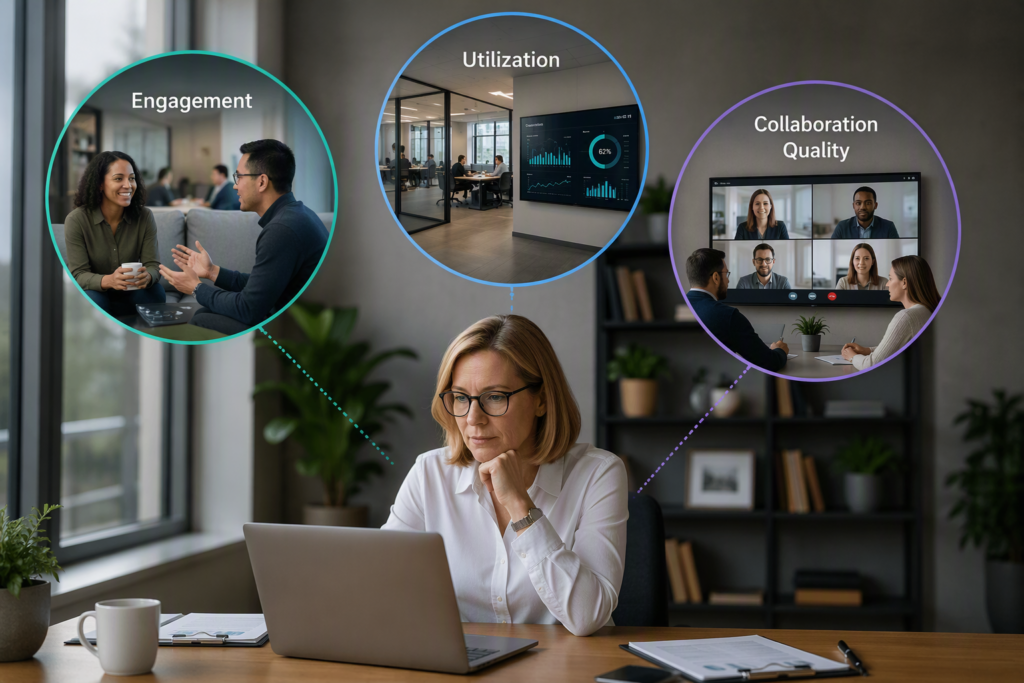
To understand hybrid workplace success, leaders should look across three categories: engagement, utilization, and collaboration quality.
1. Engagement
Employee engagement helps reveal whether the hybrid model is supporting people or draining them.
Useful engagement indicators may include:
- Employee satisfaction and pulse survey results
- Retention and turnover trends
- Manager feedback
- Participation in team events or collaboration sessions
- Reported levels of focus, flexibility, and connection
Engagement data helps answer a critical question: Are people able to do their best work in this environment?
If employees feel disconnected, unclear, or unsupported, the hybrid strategy needs attention — even if office attendance appears healthy.
2. Utilization
Utilization measures how physical spaces are being used. This may include:
- Badge data
- Room booking patterns
- Desk reservation trends
- Meeting room occupancy
- Peak office days and times
- Space types that are overused or underused
This information helps organizations understand whether the office is aligned with actual work patterns.
For example, if individual desks are empty but collaboration rooms are consistently full, the workplace may need fewer assigned workstations and more flexible team spaces. This connects directly to the ideas explored in Designing the Office as a Destination: the office must earn the commute by offering experiences people cannot easily replicate at home.
3. Collaboration Quality
Hybrid work depends on collaboration — but not all collaboration is useful.
Measuring collaboration quality means looking beyond the number of meetings or messages. More activity does not always mean better outcomes. In fact, too much synchronous activity can lead to fatigue, fragmented focus, and slower decisions.
Useful collaboration quality metrics may include:
- Meeting effectiveness scores
- Time spent in meetings
- Decision cycle times
- Project handoff quality
- Cross-functional participation
- Number of recurring meetings with clear outcomes
- Employee feedback on communication clarity
This is where asynchronous work becomes especially important. As explored in Asynchronous Work as a Hybrid Work Superpower, not every conversation needs to be a meeting, and not every decision needs to happen in real time. Measuring collaboration should help teams identify when live interaction is valuable — and when asynchronous communication would work better.
Office Usage vs. Business Outcomes
Office usage is often the most visible hybrid metric, but it can also be misleading.
Office usage can support hybrid workplace success, but only when it is connected to meaningful business outcomes. A full office does not automatically mean productive work is happening. An empty office does not automatically mean the workplace strategy has failed. The better question is whether office usage is connected to business outcomes.
For example:
- Are teams coming in for purposeful collaboration?
- Are project milestones moving faster after in-person planning sessions?
- Are new employees onboarding more effectively?
- Are client-facing teams improving responsiveness?
- Are innovation, mentoring, or problem-solving activities benefiting from office time?
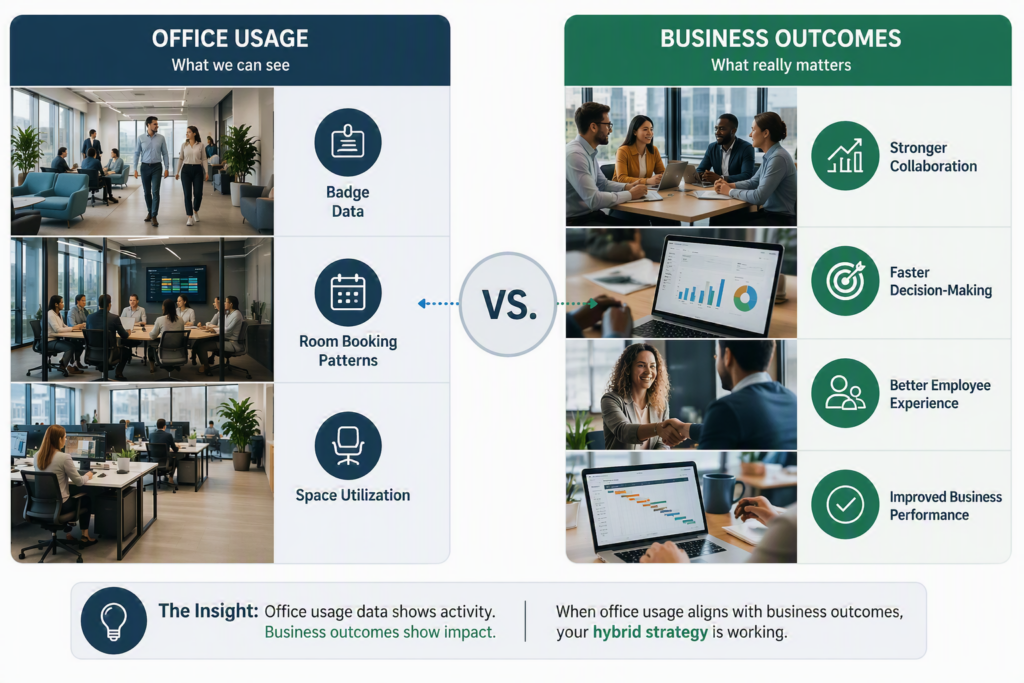
When office attendance is measured in isolation, leaders may focus on the wrong thing. But when attendance is evaluated alongside outcomes, patterns become more useful.
If people are coming in frequently but collaboration is still poor, the office experience may need redesign. If people are coming in less often but business outcomes remain strong, the hybrid model may be working better than expected.
This is the heart of hybrid workplace success: measuring what matters, not just what is easy to count.
Employee Sentiment and Feedback Loops
Hybrid work is personal. Employees experience it differently depending on roles, commute times, team norms, technology access, home environments, and manager expectations.
Employee feedback is one of the most important signals of hybrid workplace success because it reveals whether the workplace model is helping or hindering the employee experience.
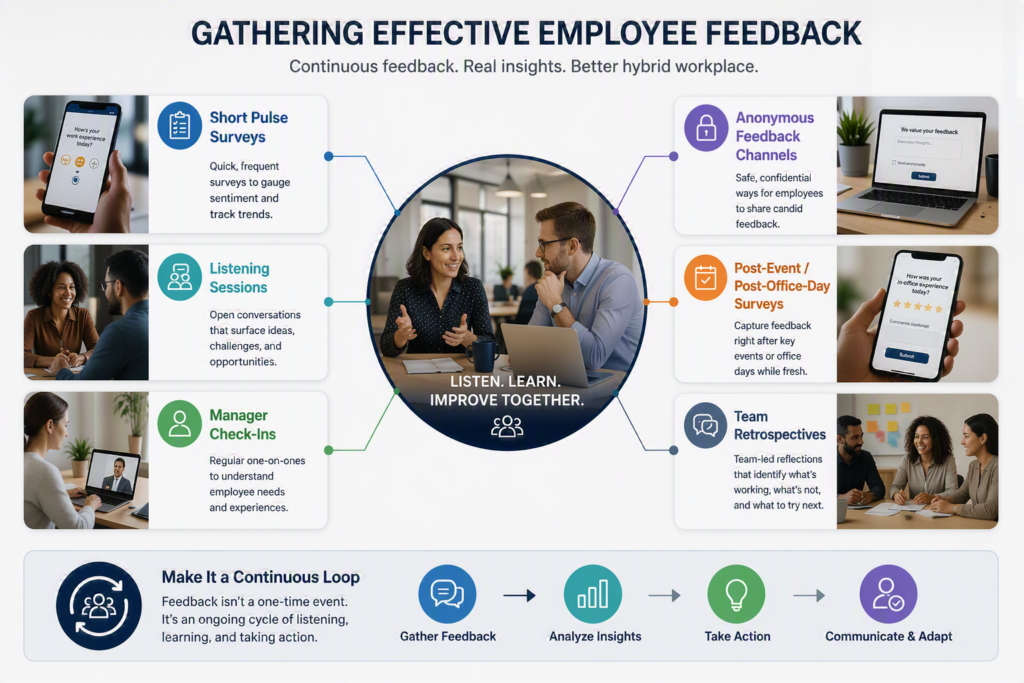
Sentiment can be gathered through:
- Short pulse surveys
- Listening sessions
- Manager check-ins
- Anonymous feedback channels
- Post-event or post-office-day surveys
- Team retrospectives
The key is to make feedback continuous, not occasional.
A once-a-year employee survey is not enough for a workplace model that changes constantly. Hybrid work is dynamic. Team needs shift. Business priorities change. Technology evolves. Office usage patterns fluctuate. Employees build new habits.
Organizations that treat feedback as an ongoing loop will be better positioned to adapt.
External research on the future of work, including Microsoft’s Work Trend Index, reinforces that work patterns continue to evolve and that leaders need better visibility into how people are collaborating, communicating, and using technology.
How to Gather Effective Employee Feedback
Employee feedback is most useful when it is specific, frequent, and tied to action. In hybrid work, a once-a-year engagement survey is too slow. Workplace patterns change quickly, so feedback needs to operate more like a continuous listening system.
1. Use short pulse surveys
Pulse surveys should be brief enough that employees actually complete them. A good cadence is monthly or quarterly, depending on how quickly workplace changes are happening.
Ask questions such as:
- “I understand when and why my team should work from the office.”
- “The office supports the work I come in to do.”
- “Remote participants are included effectively in hybrid meetings.”
- “I have enough uninterrupted focus time.”
- “Our team uses meetings, chat, email, and asynchronous tools appropriately.”
- “Hybrid work helps me do my best work.”
Use a consistent 1–5 scale so trends can be tracked over time.
2. Segment feedback by role and work pattern
Hybrid work does not affect every employee the same way. Feedback becomes more useful when segmented by:
- Department or function
- Manager or team
- Remote, hybrid, and primarily on-site employees
- New hires vs. tenured employees
- Individual contributors vs. people managers
- Commute distance or office frequency, if appropriate and privacy-safe
This helps reveal whether one group is thriving while another is struggling.
3. Combine quantitative and qualitative feedback
Scores tell leaders where the issue may be. Comments explain why.
For example, a low score on “office days are productive” could mean:
- Meeting rooms are unavailable
- Commutes feel wasted
- Key teammates are not present on the same day
- Technology in conference rooms is unreliable
- Office days are overloaded with meetings
Always include at least one open-ended question, such as:
“What is one change that would make hybrid work more effective for your team?”
4. Create feedback loops, not feedback archives
Employees stop giving useful feedback when nothing happens with it.
A strong feedback loop includes:
- Ask employees what is working and what is not.
- Analyze the patterns.
- Act on one or two visible improvements.
- Communicate what changed and why.
- Measure again to see whether the change helped.
The most important message to employees is: “We heard you, we changed something, and we are still learning.”
5. Use team retrospectives
Company-wide surveys are useful, but many hybrid work issues happen at the team level. Team retrospectives can uncover practical problems that broad surveys miss.
A simple hybrid retrospective can ask:
- What is working well about our hybrid rhythm?
- What is creating friction?
- Which meetings should be asynchronous?
- When is in-person time most valuable?
- What should we try differently next month?
This turns hybrid work into an operating practice, not just an HR policy.
Iteration Over Perfection
One of the biggest mistakes organizations make is trying to create the perfect hybrid work model before taking action.
Hybrid does not work that way.
Sustaining hybrid workplace success requires iteration, not perfection.
A strong hybrid strategy is built through iteration. Leaders set expectations, measure results, gather feedback, adjust, and repeat.
That may mean:
- Redesigning office neighborhoods based on usage data
- Replacing unnecessary recurring meetings with asynchronous updates
- Creating clearer guidance around office days
- Investing in better meeting room technology
- Training managers to lead distributed teams
- Adjusting workplace policies based on employee feedback
- Rebalancing space between focus work and collaboration
The most successful hybrid organizations are not the ones that get everything right on the first try. They are the ones that keep learning.
Practical Questions to Ask
To make hybrid workplace success measurable, leaders can start with a simple set of questions:
- Purpose: Why do we want people to come together?
- Experience: Does the office support that purpose?
- Equity: Can remote participants contribute fully?
- Engagement: Are employees energized or frustrated by the model?
- Utilization: Are spaces being used as intended?
- Collaboration: Are meetings, tools, and workflows helping teams move faster?
- Outcomes: Is hybrid work improving business performance?
- Adaptation: What have we learned, and what should we change next?
These questions shift the conversation from “How many people came in?” to “Is our workplace helping people and the business succeed?”
The Takeaway
Hybrid workplace success is not a one-time achievement. Hybrid work is a living system — measure, learn, adapt, and continue improving.
That means hybrid workplace success cannot be measured by a single metric, a single survey, or a single utilization report. It requires a balanced view of people, places, technology, collaboration, and outcomes.
Measure what matters. Listen to employees. Connect office usage to business value. Improve the experience over time.
Hybrid work will keep evolving — and the organizations that measure, learn, and adapt will be the ones that make it work.


