
Hybrid work is no longer a technology experiment. The cameras are installed, the collaboration rooms are configured, and the workflows are increasingly designed to support both synchronous and asynchronous contribution. The next frontier is not the room, the platform, or the policy.

It is leadership.
In earlier discussions, we explored asynchronous work as a hybrid work superpower, the technology blueprint for collaboration rooms, and the importance of making in-room and remote participants equal. Those are essential foundations. But even the best hybrid infrastructure will fail if management practices remain rooted in physical presence, hallway visibility, and “who seems busy.”
Hybrid work does not create weak management. It exposes it.
And just as importantly, it rewards leaders who are intentional, clear, trusting, and accountable.
From Visibility to Outcomes
For decades, many organizations used visibility as a proxy for productivity.
- Who arrived early?
- Who stayed late?
- Who was seen in meetings?
- Who was physically near the leader?
In a hybrid world, those signals become unreliable—and often misleading.
For decades, organizations used visibility as a proxy for productivity.
But research increasingly shows productivity depends more on systems and management practices than physical presence.
The employee who is quietly producing excellent work from home may be less visible than the employee who attends every in-office meeting but contributes little. The person who protects focus time may appear less “available” than someone constantly active in chat. The remote teammate may be driving the project forward asynchronously while the in-room team gets more informal recognition simply because they are easier to see.
This is why hybrid leadership requires a shift from presence-based management to outcomes-based management.
Managers must become much clearer about:
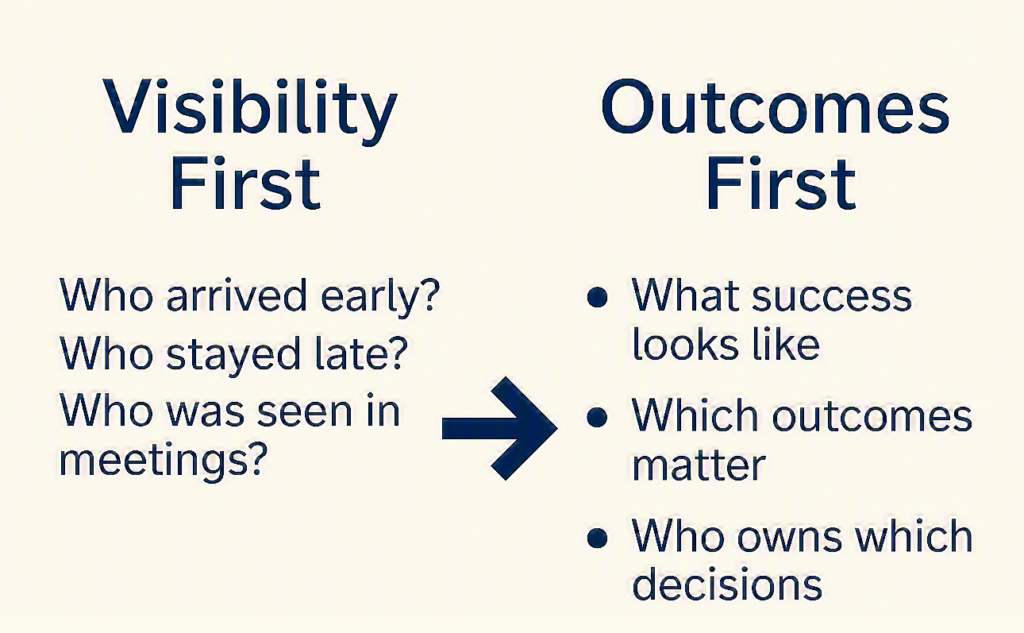
- What success looks like
- Which outcomes matter
- Who owns which decisions
- What deadlines are real
- How progress will be measured
- Where work should be documented
- When collaboration is needed—and when it is not
This is not about micromanagement. In fact, it is the opposite.
Clear expectations create freedom. When people know the desired outcome, the constraints, and the decision rights, they can move faster with less supervision. Ambiguity, by contrast, creates unnecessary meetings, duplicated work, and anxiety.
In hybrid teams, clarity is kindness. It is also operational discipline.
Trust, Autonomy, and Accountability
Hybrid work runs on trust—but trust is often misunderstood.

Trust does not mean “anything goes.” It does not mean leaders stop paying attention. It does not mean every employee works in whatever way they prefer without regard for the team.
Trust means assuming professionalism while maintaining accountability.
Autonomy and accountability must be designed together. A healthy hybrid culture gives people flexibility in how they work while being very clear about what they are responsible for delivering.
That requires managers to ask better questions:
- Are priorities clear?
- Are employees empowered to make decisions?
- Are blockers visible early?
- Are commitments being met?
- Is communication happening in the right channels?
- Is the team documenting decisions so others can stay aligned?
- Are we rewarding outcomes or just responsiveness?
The strongest hybrid leaders do not constantly monitor activity. They create operating rhythms that make progress visible without requiring surveillance.
That might include weekly written updates, project dashboards, asynchronous status notes, decision logs, or short outcome-focused check-ins. The goal is not to watch people work. The goal is to make the work legible.
When accountability is built into the system, leaders do not need to rely on proximity.
Coaching in a Hybrid Team
Coaching becomes more important in hybrid environments, not less.
In a traditional office, coaching often happened informally. A manager might notice frustration after a meeting, overhear confusion, or pull someone aside after a difficult interaction. In hybrid teams, many of those signals are reduced or delayed.
That means leaders must be more intentional.
Hybrid coaching requires regular, structured conversations that go beyond task updates. One-on-ones should not become status meetings that could have been handled asynchronously. They should create space for growth, feedback, problem-solving, and connection.
Good hybrid coaching includes questions like:
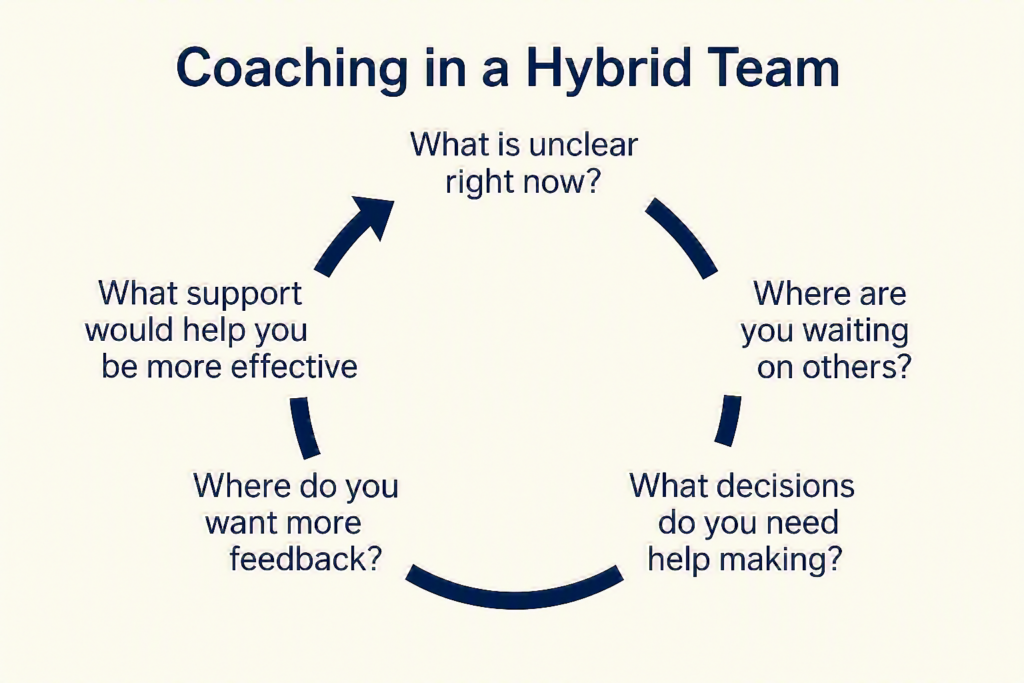
- What is unclear right now?
- Where are you waiting on others?
- What decisions do you need help making?
- What part of your work is creating the most friction?
- Where do you want more feedback?
- What support would help you be more effective?
- Are there dynamics in the team that I may not be seeing?
Managers also need to pay attention to development opportunities. In-office employees can unintentionally receive more exposure, more informal mentoring, and more stretch assignments simply because they are physically nearby. Remote employees may miss out unless leaders actively distribute opportunities.
Coaching in hybrid teams must be deliberate, equitable, and documented.
If career growth depends on being in the room, then hybrid work is not truly hybrid. It is office-first with remote exceptions.
Performance Management Must Evolve
Performance management in hybrid teams requires a more disciplined approach than many managers are used to.
When visibility decreases, vague impressions become dangerous. Leaders may overvalue responsiveness, meeting presence, or social familiarity. They may undervalue deep work, asynchronous contributions, documentation, mentoring, or behind-the-scenes problem-solving.
That can distort performance reviews.
To manage performance fairly in a hybrid world, leaders should anchor evaluations in evidence:
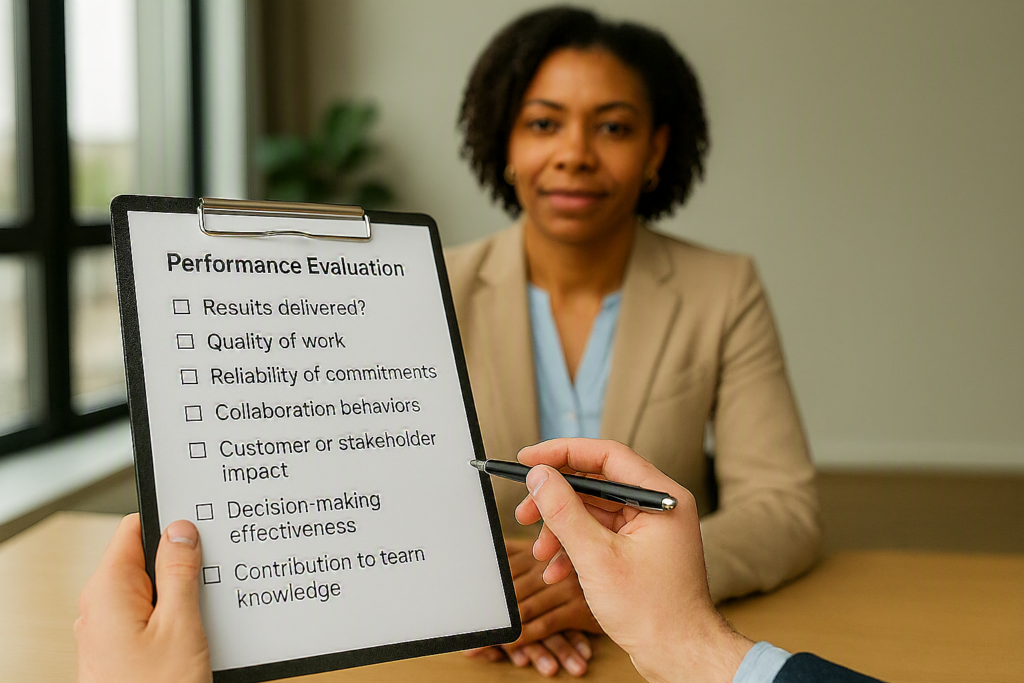
- Results delivered
- Quality of work
- Reliability of commitments
- Collaboration behaviors
- Customer or stakeholder impact
- Decision-making effectiveness
- Contribution to team knowledge
- Support for others
- Growth against agreed goals
This also means feedback must become more frequent. Annual reviews are not enough, especially when teams are distributed. Employees should know where they stand long before a formal review cycle.
Hybrid performance management should be continuous, specific, and tied to observable behaviors.
Instead of saying, “You need to be more engaged,” a manager might say, “In the last three project cycles, decisions were delayed because your updates were not posted by the agreed deadline. Let’s talk about what is getting in the way and how we can reset expectations.”
That kind of feedback is clear, fair, and actionable.
Hybrid teams need less judgment by impression and more management by evidence.
Recognizing Proximity Bias
One of the biggest risks in hybrid work is proximity bias: the tendency to favor employees who are physically present. In some surveys, a majority of leaders acknowledge this bias exists in their organizations.
It often shows up subtly.
The in-office employee gets invited into spontaneous conversations.
The person sitting near leadership gets early context.
The remote participant is spoken over in meetings.
The people in the room make decisions after the call ends.
The employee who is seen more often is perceived as more committed.
None of this requires bad intent. That is what makes it so dangerous.
Hybrid leaders must actively design against proximity bias. Equality does not happen automatically just because a meeting has a video link.
Practical steps include:
- Ensuring every meeting has a remote-friendly facilitation approach
- Avoiding side conversations that exclude remote participants
- Documenting decisions in shared spaces
- Rotating meeting times when teams span time zones
- Giving remote participants the first opportunity to speak at times
- Tracking who receives stretch assignments and recognition
- Making promotion criteria visible and outcome-based
- Training managers to recognize presence-based assumptions
The goal is not to penalize people who come into the office. The goal is to ensure that physical presence is not mistaken for higher value.
A well-run hybrid organization makes contribution visible no matter where it happens.
The Manager’s Role Is Changing
Hybrid work changes the manager’s job description.
The best managers are no longer just coordinators of activity. They are designers of clarity, trust, communication, and accountability.
They must know when a meeting is needed and when asynchronous work is better. They must understand how collaboration rooms shape participation. They must ensure remote and in-room employees are operating on equal footing. And they must build a culture where outcomes matter more than optics.
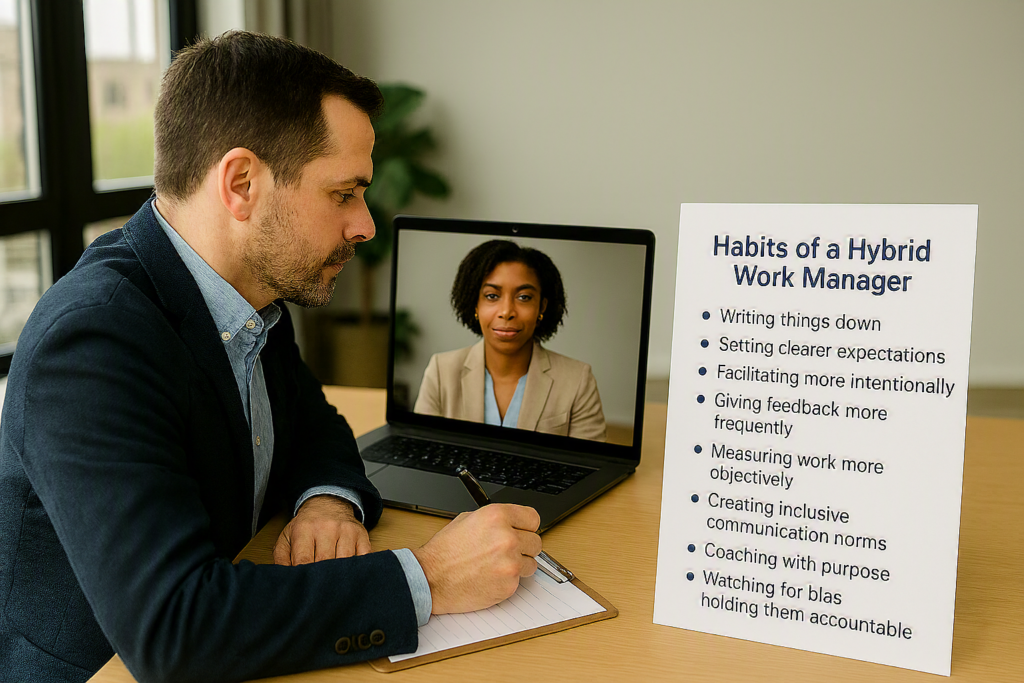
That requires new habits:
- Writing things down
- Setting clearer expectations
- Facilitating more intentionally
- Giving feedback more frequently
- Measuring work more objectively
- Creating inclusive communication norms
- Coaching with purpose
- Watching for bias
- Trusting people while holding them accountable
These are not “hybrid skills.” They are leadership skills.
Hybrid work simply makes them non-negotiable.
Hybrid Work Rewards Great Leadership
Organizations often debate hybrid work as though the core question is how many days people should be in the office.
That question matters, but it is not the whole story.
A poorly managed team can struggle five days a week in the office. A well-led team can thrive across locations, time zones, and work styles. The difference is not merely where people sit. It is how clearly they are led.
Hybrid work raises the bar. It exposes managers who rely on observation instead of outcomes, control instead of trust, and proximity instead of inclusion. But it also creates an opportunity for great leaders to stand out.
The future of hybrid work will not be won by organizations with the most polished policy or the most advanced conference room.
It will be won by organizations whose leaders know how to create clarity, build trust, coach people, measure what matters, and include everyone—whether they are in the room or on the screen.
Evidence shows hybrid models can deliver equal productivity with significantly higher retention when managed effectively
Takeaway: Hybrid work exposes weak management—and rewards great leadership.


