

Hybrid work is no longer new. As we explored in Why Hybrid Work Is Here to Stay, it has moved beyond experimentation and into permanence. And as The Cost of Doing Hybrid Poorly made painfully clear, the biggest failures in hybrid work rarely come from technology, policy, or even talent.
They come from a lack of philosophy.
When organizations skip the step of defining what they actually believe about how work should happen, everything that follows—policies, office layouts, meeting norms, technology decisions—starts to feel arbitrary. That’s when confusion and resentment take root.
This post is about slowing down long enough to define your hybrid work philosophy: the guiding principles that make every downstream decision clearer, fairer, and more intentional.
Why Philosophy Comes Before Policy
Most organizations jump straight to rules:
- How many days in the office?
- Who decides schedules?
- Which roles are eligible for remote work?
Those questions matter—but without a shared philosophy, the answers feel inconsistent. One team gets flexibility. Another doesn’t. One leader encourages autonomy. Another quietly rewards face time.
A hybrid philosophy answers a deeper question first:
What do we believe about where and how work is best accomplished—and why?
Once that belief is explicit, policies stop being debated case by case. They start reinforcing a shared direction.
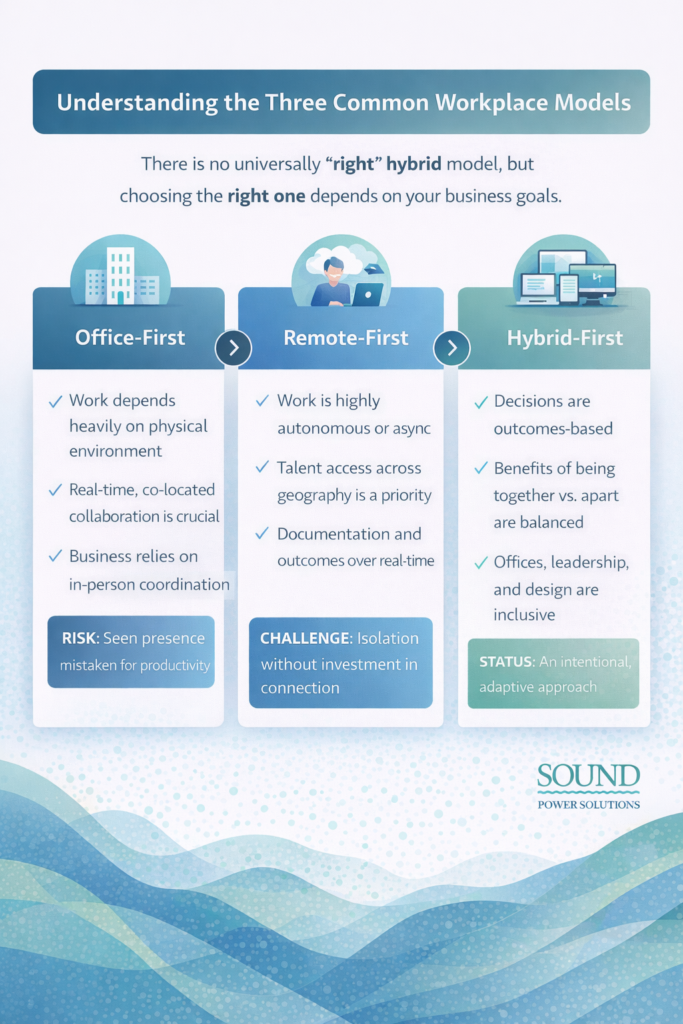
Understanding the Three Common Models
There is no universally “right” hybrid model. But there is a right one for your business goals.
Most organizations land in one of three camps—sometimes intentionally, often accidentally.
Office‑First
In an office‑first model, the default assumption is that work happens in person. Remote work is the exception.
This can work well when:
- Work depends heavily on physical equipment or environments
- Real-time, co-located collaboration is core to value creation
- The business relies on tight, in-person coordination
The risk? Without care, office‑first can slide into presenteeism—where visibility is mistaken for productivity.
Remote‑First
Remote‑first organizations design everything as if people are not co-located. Offices may exist, but they are optional.
This model works when:
- Work is highly autonomous or async
- Talent access across geography is a priority
- Documentation and outcomes matter more than real-time interaction
The challenge is intentional connection. Without clear rituals and investments in collaboration, isolation can creep in.
Hybrid‑First
Hybrid‑first is not a compromise between office and remote. It is its own posture.
Hybrid‑first organizations:
- Decide work modes based on outcomes
- Explicitly define what benefits from being together vs. apart
- Design offices, technology, and leadership behaviors around inclusion
This is where many organizations say they are—but without a philosophy, hybrid‑first easily degrades into “accidental hybrid,” with all the costs we outlined previously.
Choose Based on Business Goals—not Executive Preference
One of the fastest ways to undermine trust is tying work models to leadership comfort instead of business reality.
When hybrid decisions are driven by:
- “I work better in the office”
- “This is how we’ve always done it”
- “I need to see people working”
Employees feel it immediately. Flexibility becomes personal, not principled.
A strong hybrid philosophy connects work design to outcomes:
- Faster innovation
- Better customer experiences
- Stronger retention
- Broader talent access
- Operational resilience
This is where leadership—and often IT leadership—plays a critical role. Mature organizations treat hybrid work as a business system, not a perk. Many lean on managed IT services or vCIO programs to help align technology, security, and collaboration tools with these goals—rather than letting tools quietly dictate how people work.
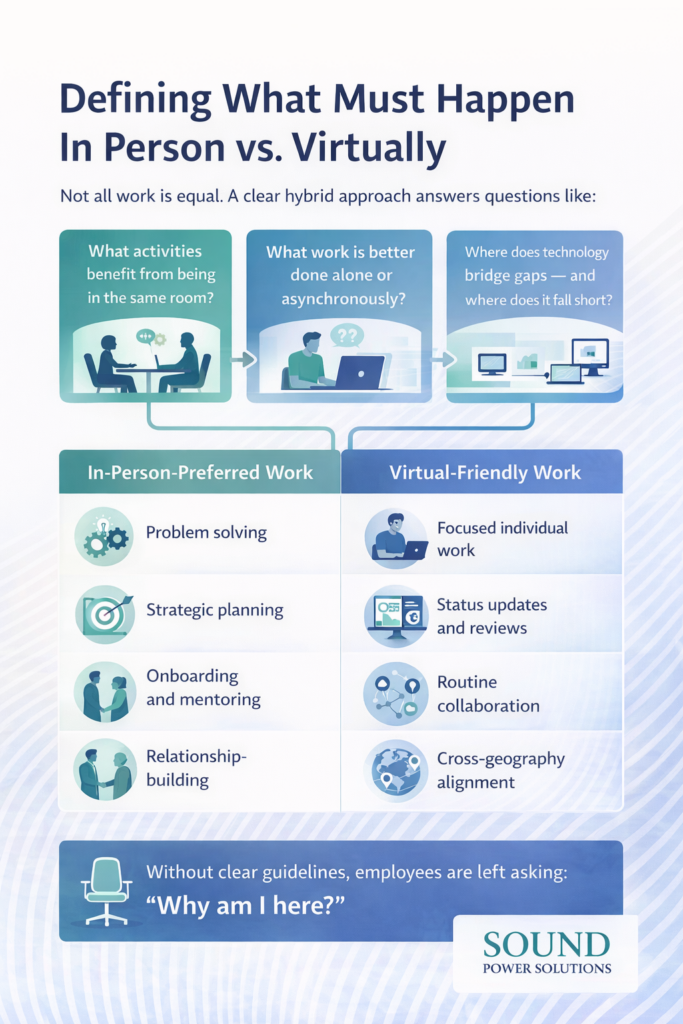
Defining What Must Happen In Person vs. Virtually
Not all work is equal. And pretending it is only creates frustration.
A clear hybrid philosophy answers questions like:
- What activities genuinely benefit from being in the same room?
- What work is better done alone or asynchronously?
- Where does technology bridge gaps—and where does it fall short?
Common examples of in‑person‑preferred work:
- Complex problem‑solving
- Strategic planning
- Onboarding and mentoring
- Relationship‑building moments
Common examples of virtual‑friendly work:
- Focused individual work
- Status updates and reviews
- Routine collaboration
- Cross‑geography alignment
When organizations don’t define this, employees are left guessing. That’s when the question “Why am I here?” starts echoing through half‑empty offices.
Aligning Leadership Behaviors to the Philosophy
A philosophy that lives only in a slide deck is worse than no philosophy at all.
Employees don’t follow policies—they follow signals.
If leaders:
- Praise people who stay late in the office
- Make decisions before meetings with only in‑person attendees
- Measure commitment by responsiveness instead of outcomes
…the real philosophy becomes clear, no matter what’s written.
Hybrid success requires leaders to model the behaviors they expect:
- Running meetings that include remote voices equally
- Evaluating performance by results, not presence
- Using the same collaboration tools as their teams
This alignment often exposes gaps—not just in leadership skills, but in systems. Reliable meeting tech, standardized collaboration tools, and secure access matter. This is where IT strategy is inseparable from workplace strategy, and why organizations increasingly rely on strategic IT partners to ensure hybrid environments actually support the philosophy being articulated.
Why This Matters More Than Ever

Without a clear hybrid philosophy:
- Policies feel arbitrary
- Offices feel pointless
- Technology feels frustrating
- Trust erodes quietly
With one:
- Expectations are clear
- Decisions scale consistently
- Bias is easier to spot
- Resentment has less room to grow
A clear philosophy prevents confusion and resentment—not by being rigid, but by being intentional.
What Comes Next
Once you’ve defined how and why work should happen, the next question becomes unavoidable:
If the office isn’t for rows of desks anymore, what is it for?
That’s where we go next—exploring the shift from cubicles to collaboration rooms, and how physical spaces must evolve to support the hybrid philosophy you’ve defined.
Because once your beliefs are clear, your spaces—and your technology—have to follow.


