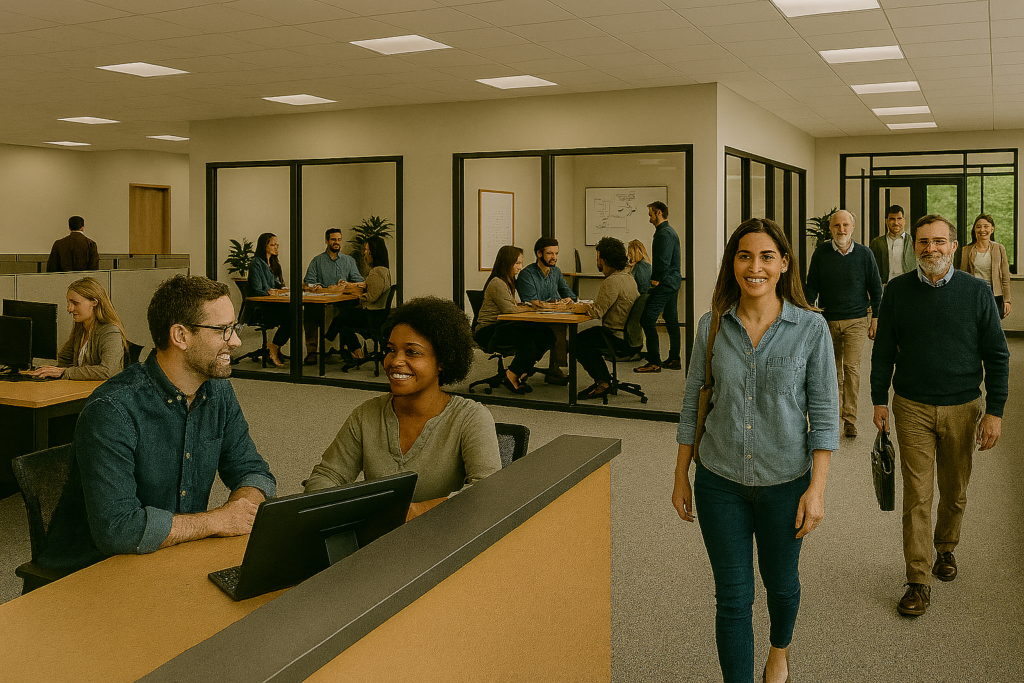
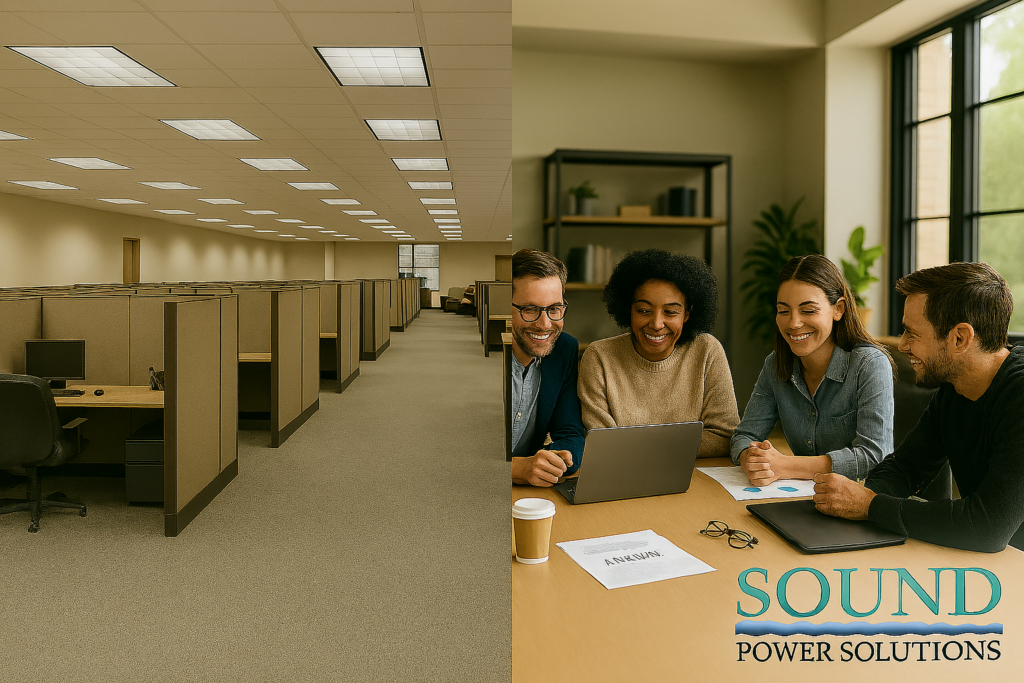
For decades, the office was designed around a simple assumption: work meant individual focus, eight hours a day, five days a week—best supported by rows of cubicles. That assumption no longer holds. Hybrid work has changed how work gets done, where focus happens, and why people come into the office at all.
If organizations want hybrid work to succeed, the physical workspace must evolve with it. That is where collaboration rooms come in!
Why Cubicles No Longer Serve Hybrid Teams
Cubicles were designed for predictable presence and heads‑down productivity. Hybrid teams don’t operate that way. People now do their most focused, individual work at home—where interruptions are fewer and autonomy is higher. When employees come into an office built around cubicles, they’re often forced to replicate what they already do better elsewhere.
This creates a familiar frustration:
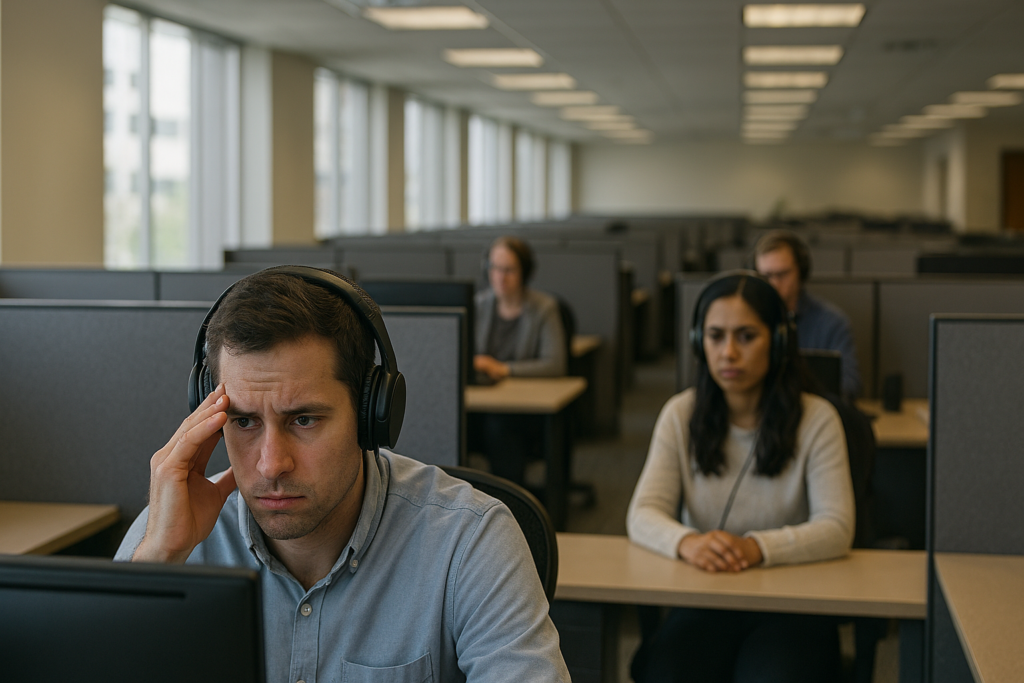
- The office feels half full, yet strangely unenergized
- Meetings still happen on video—even when everyone is on site
- Noise‑canceling headphones become mandatory
- Employees quietly ask, “Why am I here?”
Cubicles optimize for presence, not outcomes. In a hybrid world, that mismatch makes offices feel outdated, inefficient, and expensive.
The Rise of Collaboration Rooms, Huddle Spaces, and Open Studios
Hybrid work elevates collaboration as the primary reason for being together. That shift demands a different kind of space.
Collaboration rooms support deeper problem‑solving, planning, and decision‑making.
Huddle spaces encourage quick alignment, informal conversations, and spontaneous check‑ins.
Open studios invite creativity, cross‑functional work, and experimentation.
These environments:
- Lower friction for teamwork
- Encourage inclusive participation across in‑person and remote attendees
- Create energy that’s difficult to replicate virtually
- Help teams move faster when complexity demands shared context
Instead of isolating people, these spaces pull them together with intention.
Designing Spaces for Problem‑Solving—Not Heads‑Down Work
One of the most important hybrid design insights is simple: not all work belongs in the office.
Focused individual tasks—writing, analyzing, reviewing—often thrive outside it. The office’s greatest strength is what can’t be done alone:

- Complex problem‑solving
- Strategic planning
- Onboarding and mentoring
- Relationship‑building
- Creative collaboration
When office design prioritizes these moments, the space stops feeling redundant and starts feeling valuable. The question shifts from “How many desks do we need?” to “What outcomes should this space enable?”
Right‑Sizing Real Estate for Hybrid Usage Patterns
Hybrid work also exposes how much real estate was optimized for assumptions that no longer exist.
With fluctuating attendance, assigned desks often sit empty. Smart organizations respond by:
- Reducing underutilized desk space
- Investing in flexible, multi‑use rooms
- Designing for peak collaboration days instead of daily maximums
- Aligning square footage with actual usage patterns
Right‑sizing isn’t about shrinking for the sake of savings—it’s about reallocating space toward what creates value.
Technology That Disappears Into the Experience
Modern collaboration spaces must also be hybrid‑ready. Reliable audio, intelligent cameras, shared displays, and seamless one‑touch join experiences aren’t nice‑to‑haves—they’re essential.
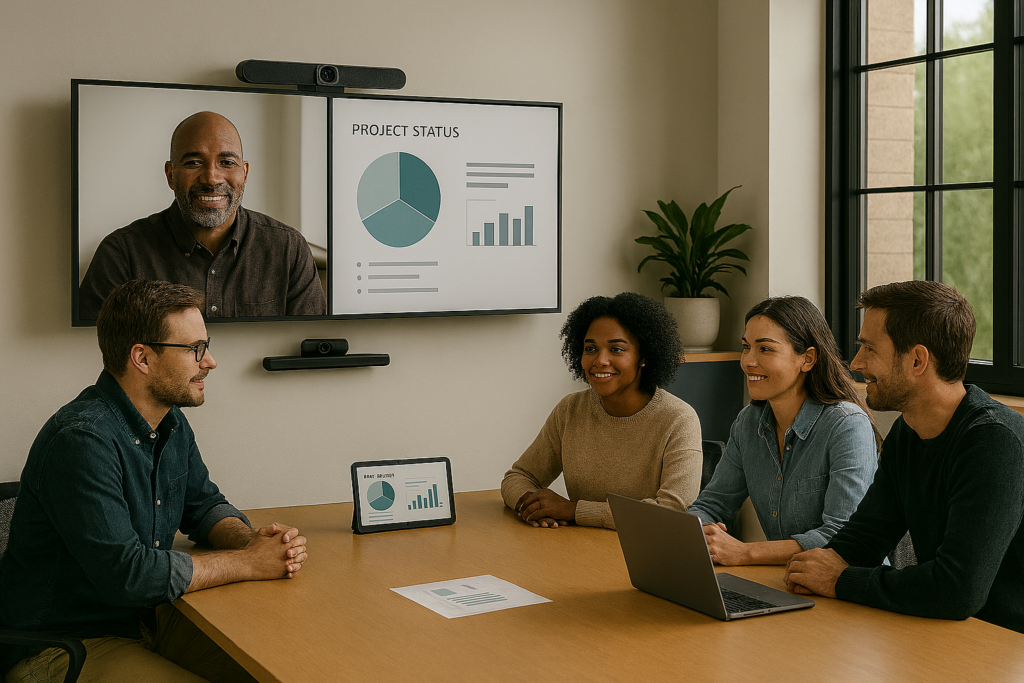
When technology works invisibly:
- Remote participants feel equal, not secondary
- Meetings focus on outcomes instead of troubleshooting
- Friction fades into the background
The goal isn’t better rooms—it’s better experiences.
Takeaway
Offices should amplify collaboration—not replicate home offices.
In a hybrid world, the office is no longer a default destination. It’s a strategic one. When designed intentionally, it becomes a catalyst for connection, creativity, and progress—rather than a relic of outdated work patterns.