
Hybrid work isn’t new anymore—but equitable hybrid collaboration still is. Too often, meetings that include both in-room and remote participants unintentionally create two different experiences: one rich, fast, and conversational… and another fragmented, delayed, and sidelined. If left unchecked, this imbalance erodes trust, participation, and ultimately performance.
If hybrid work is going to sustain itself, organizations must design deliberately for equality—not convenience.
Why Hybrid Meetings Often Fail
Most hybrid meetings fail for a simple reason: they are designed for the room, not the group.
When a meeting centers on those physically present, remote participants experience:

- Audio and visibility gaps (side conversations, poor mic pickup)
- Delayed participation (difficulty jumping into fast-paced discussions)
- Reduced influence (ideas overlooked or attributed later)
- Decision opacity (conclusions formed informally in-room)
In-room attendees benefit from body language, proximity, and informal cues. Remote participants rely entirely on structured interaction—and when that structure doesn’t exist, they fall behind.
The result isn’t just inconvenience—it’s inequity.
Designing for “One Experience” Regardless of Location
The solution is not better tools alone—it’s intentional design.
Design principle: Everyone joins the same meeting, not different versions of it.
This often means flipping the default:
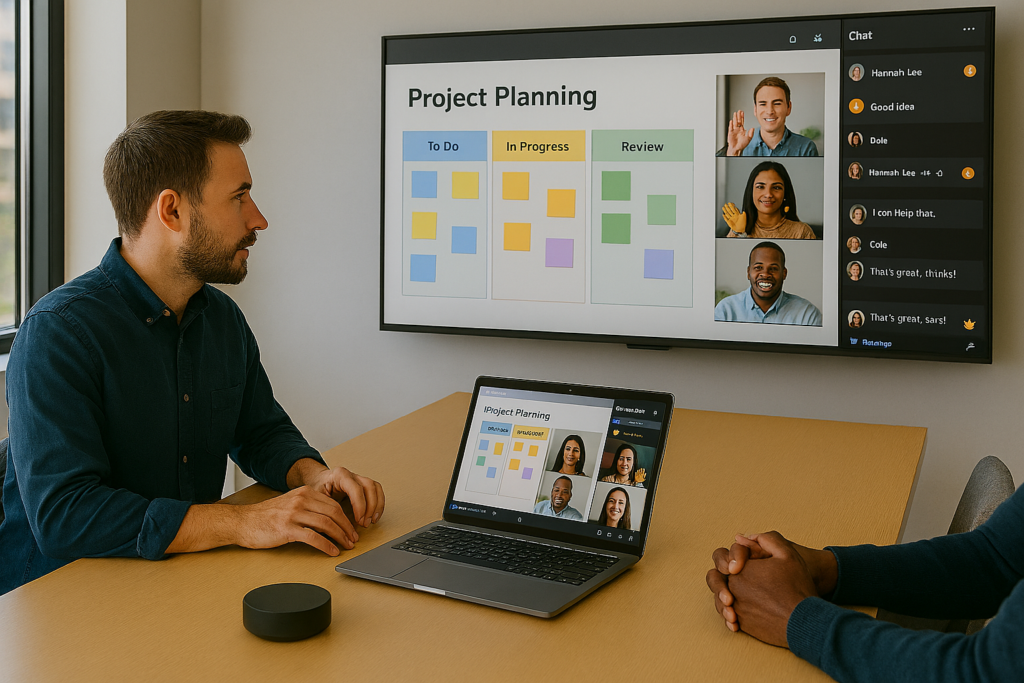
- Even in-office participants join via their own devices (laptop-first model)
- Shared digital workspaces replace physical whiteboards
- Cameras and audio are optimized for individuals, not rooms
- Materials are accessible equally before, during, and after the meeting
Instead of asking, “How do we include remote participants?”
Ask, “How do we remove the distinction between remote and in-room?”
Key practices:
- Use collaborative platforms (documents, boards, polls) as the primary interaction layer
- Ensure every voice has a channel (chat, reactions, hand raise)
- Make what’s visible to one visible to all
When everyone experiences the meeting the same way, location becomes irrelevant.
Inclusion Strategies for Remote Voices
Equity doesn’t happen automatically—it must be facilitated.
Remote participants are less likely to interrupt, interject, or compete for airtime. That means leaders and facilitators must actively design inclusion into the flow.
Tactics that work:
1. Structured turn-taking
- Explicitly call on participants, rotating between remote and in-room
- Avoid “open floor” dominance by whoever is most visible
2. Chat-first contributions
- Encourage ideas via chat before verbal discussion
- Surface remote input early so it shapes the conversation
3. Moderation roles
- Assign a remote advocate or moderator to monitor chat and raise unseen voices
- Separate facilitation from participation when possible
4. Equal speaking mechanics
- Use round-robin input, timeboxed responses, or digital polling
- Normalize pauses to create entry points for remote speakers
5. Presence signaling
- Cameras on when possible, but don’t rely on video for engagement
- Use reactions, emojis, or quick polls to maintain visibility of participation
Inclusion is not about being polite—it’s about ensuring influence is evenly distributed.
Meeting Norms That Favor Outcomes, Not Presence
Many hybrid dysfunctions stem from outdated norms: attendance equals contribution, and presence equals importance.
Effective hybrid teams shift toward outcome-driven meetings:
Replace this:
- “Who’s in the room decides the outcome”
- “Speak up or miss your chance”
- “We’ll follow up with remote participants later”

With this:
- Pre-work and async input: Gather perspectives before the meeting
- Clear decision frameworks: Define how input translates into outcomes
- Documented agreements: Capture decisions in shared spaces in real time
- Time-bound facilitation: Prevent dominance by a few voices
Meetings become less about who spoke and more about what was decided—and why.
When outcomes—not presence—drive value, equity follows naturally.
The Real Risk: Silent Disengagement

Hybrid inequity rarely fails loudly.
Instead, it looks like:
- Cameras off
- Fewer contributions
- Declining idea diversity
- Quiet exits from conversations—and eventually, the organization
Remote participants don’t usually protest inequity. They adapt to it—by disengaging.
That’s the collapse risk.
Hybrid Collaboration Takeaway
If remote participants feel secondary, the model will collapse.
Hybrid collaboration isn’t a technology problem—it’s a design problem. The organizations that succeed will be those that:
- Design for one shared experience
- Facilitate inclusive participation intentionally
- Anchor meetings around outcomes, not location
In the end, hybrid work only works when everyone has an equal seat at the table—no matter where that table is.