

If employees can answer email, attend meetings, review documents, and complete routine tasks from home, what makes the office worth the commute?
For many organizations, the answer is not free coffee, upgraded break rooms, ping pong tables, catered lunches, or mandatory attendance policies.
The answer is creating opportunities for employees to accomplish things together that are difficult to achieve apart.
Over the last several years, business leaders have debated remote work, hybrid work, and return-to-office strategies from nearly every angle imaginable. Yet many organizations continue to approach the conversation from the wrong perspective. The question is not whether employees should work remotely or in the office. The more important question is whether coming to the office creates measurable value for employees, customers, and the organization itself.
For many organizations, the challenge is no longer deciding where employees work. The challenge is developing a workplace collaboration strategy that helps people communicate effectively, share knowledge, make decisions, and serve customers regardless of location.
A successful workplace collaboration strategy recognizes that the office itself is not the objective. The objective is creating an environment where teams can accomplish together what would be more difficult to achieve separately.
When people can complete many individual tasks from virtually anywhere, simply requiring attendance is rarely enough to justify the commute. Employees want their time to be spent effectively. Business leaders want productivity, innovation, strong client service, knowledge sharing, efficient decision-making, and sustainable growth.
This idea builds on a concept we explored in Designing the Office as a Destination. In that article, we discussed how successful organizations are rethinking the purpose of physical space, moving away from the idea of the office as simply a place where people work and toward the concept of the office as a destination for collaboration, learning, innovation, and relationship building. This article takes the next step by exploring what actually makes that destination valuable once employees arrive.
Organizations that view workplace collaboration strategy as a business initiative rather than a facilities decision are often better positioned to improve productivity, accelerate decision-making, strengthen communication across teams, and create a better experience for both employees and customers.
In other words:
People don’t come to the office because of the office. They come because they can accomplish something there that is harder to accomplish elsewhere.
For business owners, managing partners, executive directors, and operations leaders, this distinction matters. It has a direct impact on productivity, customer satisfaction, project delivery, organizational continuity, employee development, and long-term business performance.
The office becomes worth the trip when it serves a purpose.
Collaboration Happens Faster Face-to-Face
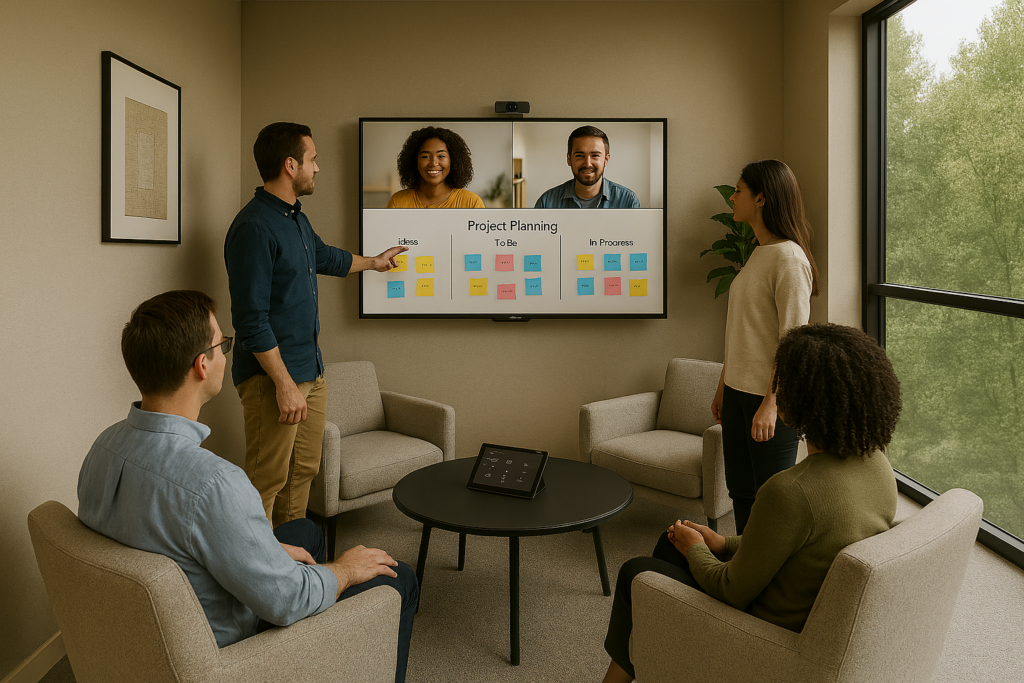
Not every conversation belongs in a scheduled meeting.
Not every problem requires a lengthy Teams chat.
And not every decision should take twenty emails, three calendar invites, and two weeks of back-and-forth discussion.
One of the greatest advantages of bringing people together is speed.
A thirty-second conversation between two colleagues can replace countless digital interactions.
Imagine a project manager who needs clarification on a client requirement. In a fully distributed environment, the process might involve:
- Sending an email
- Waiting for a response
- Scheduling a meeting
- Discussing the issue
- Following up with documentation
When those same individuals are working together in person, the discussion may happen spontaneously and be resolved in minutes.
This effect becomes even more significant when multiple stakeholders are involved.
Why Workplace Collaboration Strategy Matters
The most effective workplace collaboration strategy is not built around attendance requirements.
It is built around identifying the types of work that benefit most from real-time interaction.
Business leaders should evaluate where collaboration creates measurable value. These opportunities often include strategic planning, client problem solving, project reviews, innovation workshops, mentoring conversations, and executive decision-making sessions.
When workplace collaboration strategy is aligned with business objectives, organizations often experience faster decision-making, fewer communication breakdowns, improved project outcomes, and stronger customer experiences.
Professional Services
Professional services firms often deal with complex client engagements that require expertise from multiple disciplines. Consultants, accountants, attorneys, engineers, architects, and advisors frequently encounter situations where a solution emerges through discussion rather than individual analysis.
A conference room conversation among team members can uncover risks, identify opportunities, and produce solutions far more quickly than asynchronous communication. Solutions like this and more are discussed more in depth at our page on technology for professional services page.
Healthcare
Healthcare organizations depend heavily on timely communication. Whether coordinating patient care, managing operations, or implementing technology improvements, healthcare professionals often benefit from immediate collaboration.
Questions can be answered quickly, issues escalated efficiently, and decisions communicated more effectively when key stakeholders can connect directly. Our page on technology services for healthcare organizations can provide further insight on technology options for healthcare workplace collaboration strategy.
Construction
Construction projects involve owners, architects, engineers, contractors, subcontractors, inspectors, suppliers, and consultants. A single unresolved issue can impact schedules, budgets, change orders, resource planning, and customer expectations.
Bringing the right stakeholders together for planning sessions, project reviews, and issue resolution meetings can compress days of communication into a single productive conversation. Whether coordinating field operations, reviewing project documentation, or addressing unforeseen challenges, collaboration remains a competitive advantage.
For organizations operating in construction and related industries, these communication and coordination challenges are precisely why technology strategy and workplace collaboration are so closely connected. Learn more about Sound Power Solutions’ Technology Services for Construction Companies to see how technology can impact collaboration in the construction environment.
The Collaboration Advantage
The value of face-to-face collaboration isn’t that people are physically present.
The value is that barriers to communication disappear.
Questions get answered faster.
Ideas evolve more rapidly.
Decisions happen sooner.
Problems get solved before they become larger problems.
For many organizations, collaboration remains one of the strongest reasons to bring people together intentionally. This makes it essential to include it in your workplace collaboration strategy.
Knowledge Transfer Is Easier In Person
Many organizations underestimate how much learning occurs outside formal training programs.
Most critical business knowledge does not live in manuals, procedures, or recorded webinars.
It lives in people.
Experienced employees carry years of context, judgment, relationships, and institutional knowledge that can be difficult to document completely.
Unfortunately, organizations frequently discover the importance of that knowledge only after key employees retire, change roles, or leave.
Effective knowledge transfer happens continually through everyday interaction.
Consider the new employee who learns by:
- Listening to discussions among senior staff
- Observing how difficult decisions are made
- Watching experienced employees navigate client conversations
- Asking quick questions throughout the day
- Seeing how problems are actually solved
These learning opportunities often happen naturally when people share the same environment.
Knowledge Sharing as a Strategic Advantage
Knowledge transfer is one of the most overlooked components of a workplace collaboration strategy.
Many organizations focus heavily on software platforms, workflows, and policies while overlooking the informal learning that occurs through daily interactions. Yet these interactions often determine how quickly employees develop expertise and become productive contributors.
An effective workplace collaboration strategy creates intentional opportunities for employees to learn from one another through mentorship, observation, project work, and collaborative problem solving.
For organizations concerned about succession planning and long-term continuity, knowledge sharing should be considered a strategic business priority rather than an operational afterthought.
The Power of Observation
Formal training teaches process.
Observation teaches judgment.
A new employee may learn how to complete a task from documentation. They learn why decisions are made by watching experienced leaders work through real situations.
That context often makes the difference between someone who merely follows a process and someone who understands how to adapt when circumstances change.
Protecting Organizational Continuity
Knowledge transfer is not simply an employee development issue.
It is a business continuity issue.
When organizations struggle to transfer knowledge, productivity slows, onboarding takes longer, project risk increases, and critical expertise becomes concentrated within a small number of individuals. For executive teams and business owners, that creates both operational risk and succession risk.
Organizations that intentionally create opportunities for mentorship, shadowing, and collaboration help ensure institutional knowledge is distributed across the organization rather than trapped within individual employees.
Relationships Still Matter

Strong workplace relationships improve:
- Communication
- Trust
- Accountability
- Problem solving
- Team effectiveness
Technology can support relationships.
It cannot replace them.
Collaboration Depends on Trust
Every successful workplace collaboration strategy is ultimately built on relationships.
Teams that trust one another communicate more openly, share information more freely, and resolve challenges more effectively. While technology makes communication easier, trust still develops through human interaction and shared experiences.
This is one reason many organizations continue to create intentional opportunities for in-person collaboration even as hybrid work models mature. Stronger relationships often lead to stronger collaboration, better accountability, and improved organizational performance.
Trust Is Built Through Interaction
Trust develops through repeated interactions over time.
It emerges when people solve problems together, navigate challenges together, and learn how one another think and communicate.
When trust increases, friction often decreases.
Employees become more comfortable asking questions, sharing concerns, raising issues, and seeking help when they need it.
Better Communication Leads to Better Decisions
When teams have strong working relationships, information flows more naturally.
Potential issues surface sooner.
Decisions happen more quickly.
Blind spots are identified earlier.
The result is often better business outcomes and fewer surprises for leadership teams.
The Office Should Be a Collaboration Hub, Not a Cubicle Farm
If employees are expected to drive to the office, sit in individual cubicles, put on headphones, and spend the day attending Teams meetings, the obvious question becomes:
Why commute at all?
The most effective modern workplaces are designed around activities that benefit from bringing people together.
As we discussed in Designing the Office as a Destination, people rarely commute for amenities alone. They come together because there is value in being together. The office becomes a destination when it accelerates collaboration, learning, planning, and decision-making in ways that cannot be replicated as effectively elsewhere.
The organizations getting the most value from their office investments are not necessarily those with the newest furniture or largest floor plans.
They are the organizations that intentionally design spaces around how work actually happens.
Designing Spaces Around Workplace Collaboration Strategy
The most successful workplace collaboration strategy considers both physical and digital environments.
Conference rooms, project spaces, training areas, innovation labs, meeting environments, and client collaboration areas should support the types of interactions leaders want to encourage.
If innovation matters, create spaces that encourage innovation.
If mentoring matters, create environments that support mentoring.
If cross-functional teamwork matters, design spaces where those interactions can happen naturally.
If customer experience matters, create environments where teams can collaborate effectively around customer needs.
A workplace collaboration strategy should influence not only how people work, but also how workspaces are designed.

Modern offices should support:
- Team planning
- Project workshops
- Client meetings
- Training sessions
- Strategy development
- Mentoring conversations
- Cross-functional collaboration
The goal is not simply filling a building.
The goal is creating a destination that supports organizational outcomes. Employees are far more likely to view office attendance positively when the environment helps them solve problems, learn from one another, and move work forward.
Technology Makes the Difference
The conversation should not be framed as:
Office or remote?
The better question is:
How do we create a connected workplace regardless of location?
Technology Enables Workplace Collaboration Strategy
Technology plays a central role in every modern workplace collaboration strategy.
Organizations no longer operate from a single building, nor do employees interact exclusively through face-to-face conversations. Teams frequently work across locations, departments, time zones, and organizational boundaries.
A workplace collaboration strategy must therefore include technology that supports:
- Communication
- Document management
- Knowledge sharing
- Workflow automation
- Project coordination
- Secure access to information
- Data-driven decision making
The tools matter less than the capabilities they provide.
Organizations should focus on creating:
- A single source of truth for information
- Consistent communication channels
- Secure access from anywhere
- Efficient document collaboration
- Automation of routine business processes
- Faster knowledge discovery
- Better decision support
Microsoft technologies such as Teams, SharePoint, OneDrive, Microsoft 365 Copilot, and the Power Platform help deliver these capabilities in different ways.
According to Microsoft’s 2026 Work Trend Index, researchers analyzed trillions of workplace signals and surveyed 20,000 workers across 10 countries. The report found that organizational factors such as culture, leadership support, and operating practices have a greater impact on technology success than individual effort alone. The research also found that nearly half of Microsoft 365 Copilot interactions support cognitive work such as analyzing information, solving problems, evaluating options, and creative thinking.
However, the goal of a workplace collaboration strategy is not technology adoption for its own sake.
The goal is creating a connected environment where employees can quickly access information, communicate effectively, and collaborate efficiently.
Organizations that align technology investments with workplace collaboration strategy often reduce information silos, improve operational efficiency, accelerate decision-making, and create better employee and client experiences.
Microsoft Teams
Teams helps keep conversations connected to projects and business activities while enabling collaboration regardless of location.
SharePoint
SharePoint creates structured information repositories that reduce duplication, improve governance, and make organizational knowledge easier to access.
OneDrive
OneDrive provides secure access to files, improving employee flexibility without sacrificing security or productivity.
Microsoft 365 Copilot
Copilot helps employees find information faster, summarize content, generate drafts, and spend less time on repetitive administrative work.
Power Platform
Power Platform enables organizations to automate workflows, streamline processes, and eliminate manual effort that slows productivity.
Organizations looking to maximize value from Microsoft 365 should view these technologies as components of a broader workplace collaboration strategy rather than standalone products. Learn more about Sound Power Solutions’ Microsoft 365 Support Services and how we can help your organization align M365 with your workplace collaboration strategy.
Likewise, the underlying office infrastructure remains critical. Reliable networking, secure connectivity, collaboration devices, conference room technology, and workplace systems all contribute to how effectively employees can work together. Learn more about our Managed Office Infrastructure Services to make technology in the office space seamless.
Technology should not force people into a location.
Technology should enable better outcomes everywhere.
Information Chaos Makes Every Workplace Worse
One of the greatest barriers to workplace productivity is not location.

It is information chaos.
Employees lose valuable time:
- Searching for documents
- Looking through email chains
- Finding the latest version of a file
- Determining which source is correct
- Asking coworkers where information is stored
- Recreating work that already exists
Information Management Supports Collaboration
Even the most thoughtful workplace collaboration strategy can fail when information is difficult to locate.
Employees waste valuable time searching for documents, reviewing email history, tracking down file versions, and determining which information source should be trusted. These challenges create friction regardless of whether employees are working in an office, from home, or at a client site.
A mature workplace collaboration strategy requires strong information management practices that ensure employees can easily locate accurate and current information when they need it.
Collaboration improves significantly when people spend less time searching and more time working.
Organizations should focus on creating:
- Clear information management practices
- Shared knowledge repositories
- Consistent collaboration tools
- Well-defined governance models
- Standardized document management processes
When information is organized effectively, both in-person and remote collaboration become significantly easier.
Focus on Outcomes, Not Locations
Perhaps the most important lesson from the workplace evolution of the past several years is this:
Location is not the objective. Results are.
Successful organizations ask:
- Are employees productive?
- Are clients being served effectively?
- Are teams collaborating successfully?
- Is information accessible?
- Are decisions being made efficiently?
- Are projects progressing?
- Are business goals being achieved?
These questions matter far more than where employees happen to be sitting.
Measuring the Success of Workplace Collaboration Strategy
A common mistake organizations make is measuring attendance while ignoring outcomes.
The success of a workplace collaboration strategy should be evaluated through business results rather than physical presence.
Leaders should ask:
- Are projects moving faster?
- Are clients receiving better service?
- Are decisions being made more efficiently?
- Is knowledge being shared effectively?
- Are employees finding information quickly?
- Are teams collaborating successfully?
These indicators provide a far more meaningful measure of organizational effectiveness than simple attendance metrics.
Attendance becomes a byproduct of value.
This is ultimately the same principle behind designing the office as a destination. The most effective workplace strategies do not rely on mandates. Instead, they create conditions where employees recognize that being together helps them work more effectively, make better decisions, strengthen relationships, develop professionally, and serve clients more successfully.
When workplace collaboration strategy is successful, employees frequently choose to come together because doing so helps them achieve better outcomes.
Conclusion: Purpose Makes the Office Worth the Trip
In Designing the Office as a Destination, we argued that organizations should think differently about physical workspace. The office should not be viewed as an obligation. It should be viewed as a resource.
A successful workplace collaboration strategy expands on that idea by focusing on the reason people come together in the first place.
What makes an office worth the trip is not the building itself. It is the ability to collaborate more effectively, transfer knowledge more efficiently, strengthen relationships, accelerate decision-making, and solve problems together.
The offices that are worth the trip are not defined by amenities.
They are defined by purpose.
People do not commute because a building exists. They commute because that building helps them accomplish something valuable.
The organizations creating the most effective workplaces today are not choosing between in-office and remote work. They are creating workplace collaboration strategies that support business outcomes regardless of location.
Technology should not force organizations to choose between office and remote work. It should help teams perform effectively regardless of location while making in-person collaboration more valuable when it occurs.
Ultimately, the goal is not to maximize attendance.
The goal is to maximize outcomes.
And when organizations focus on outcomes, the question of whether the office is worth the trip becomes much easier to answer.
Because the most effective workplaces are not places employees are required to go.
They are places employees choose to go because being there helps them succeed.
How Sound Power Solutions Can Help
If your organization is evaluating its workplace collaboration strategy and looking for ways to improve productivity, communication, information management, or Microsoft 365 adoption, Sound Power Solutions can help.
We work with organizations to assess current environments, align technology with business objectives, improve information governance, and create practical roadmaps for collaboration and operational efficiency. Whether you’re modernizing Microsoft 365, improving information management, enhancing workplace technology, or developing a long-term digital workplace strategy, our team can help you build an environment where people can do their best work, regardless of location.


