Hybrid work is no longer a question of if.
That chapter is closed.
As we explored in Why Hybrid Work Is Here to Stay, hybrid models have proven their value—from productivity gains and wider access to talent to better engagement and retention. When designed intentionally, hybrid work becomes a competitive advantage.
But there’s a hard truth many organizations are now facing:
Hybrid work doesn’t fail because work is distributed.
It fails because it’s poorly defined.
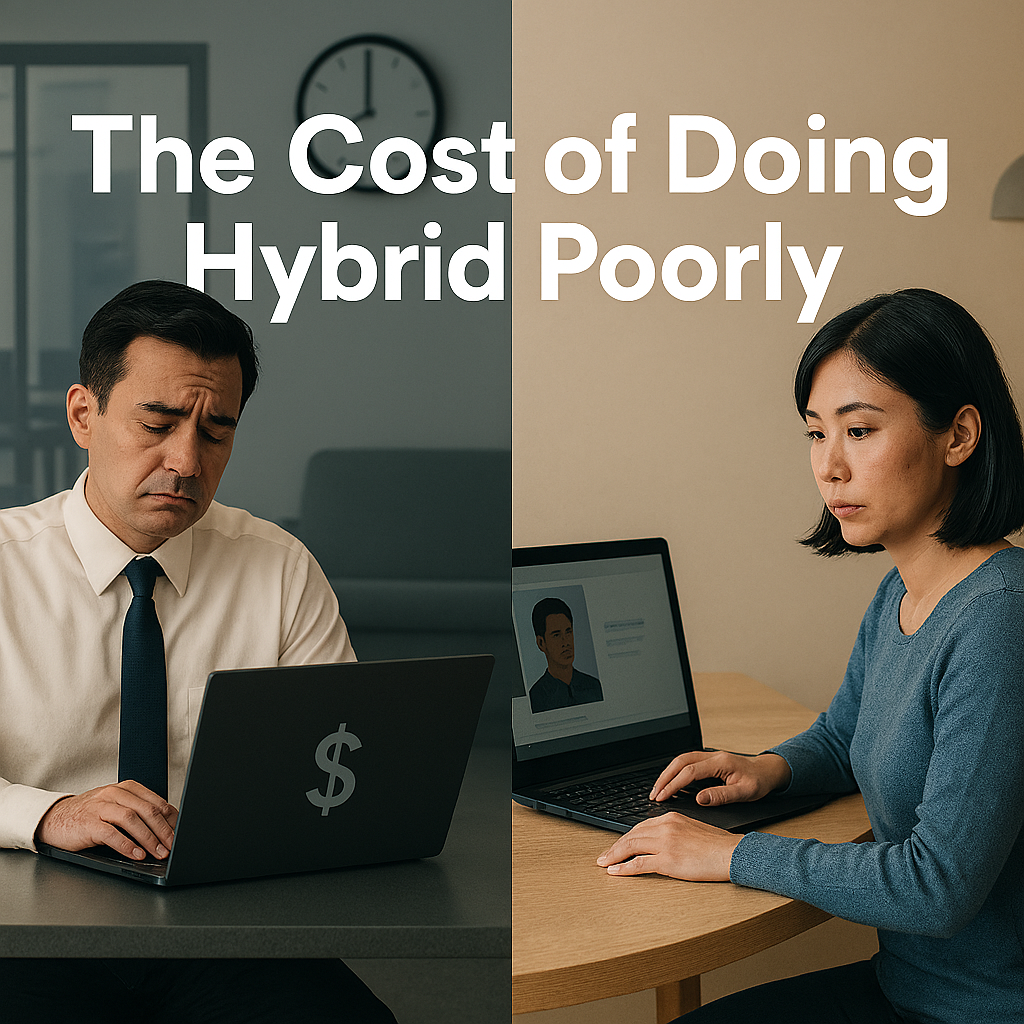
When hybrid is implemented without clarity, equity, and purpose, the costs show up everywhere—financially, culturally, and operationally.
The Illusion of Presence: Empty Offices and Disengaged Teams
One of the earliest warning signs of accidental hybrid is the half‑full office.
Laptops are open. Desks are occupied.
But energy, collaboration, and focus are missing.
People come in because policy dictates it—not because the office enables better work. Meetings still happen on video. Heads‑down work still requires noise‑canceling headphones. The commute adds friction without adding value.

Over time, employees begin asking the same question:
“Why am I here?”
When the answer isn’t clear, engagement fades. The office turns into an expensive artifact of old habits rather than a purposeful collaboration space.
Tech Friction Quietly Drains Productivity
Hybrid work depends on technology—but poorly executed hybrid amplifies every technical weakness.
Common symptoms include:
- In‑room meetings that don’t work for remote participants
- Inconsistent audio and video experiences
- Too many overlapping tools
- Wi‑Fi and room systems that “usually work”
Each issue feels small. Collectively, they create constant friction.
Instead of technology enabling collaboration, it becomes a barrier—adding minutes, interruptions, and frustration to every interaction. Productivity erodes not because people aren’t working, but because work takes longer than it should.
Productivity Loss From Unclear Expectations
Perhaps the biggest cost of doing hybrid poorly is ambiguity.
When people don’t know:
- When they’re expected to be in the office
- Why in‑person work matters
- How performance is evaluated
- Whether visibility matters more than outcomes
…they make assumptions.
Some over‑compensate by being “always available.”
Others disengage, unsure where to invest effort.
Managers revert to measuring presence instead of progress.
The result isn’t flexibility—it’s confusion. And confusion is one of the fastest ways to destroy productivity.
Hybrid work thrives on trust and clarity. Without them, every decision becomes political instead of practical.
The Two‑Class Workforce Problem
One of the most damaging effects of accidental hybrid is the emergence of a two‑class workforce.

Not by policy—but by proximity.
Employees who spend more time in the office often:
- Get more informal access to leaders
- Receive more recognition
- Are perceived as more committed
- Influence decisions before meetings even start
Meanwhile, remote employees—regardless of performance—can feel invisible.
Over time, this creates real inequity:
- Promotions skew toward those physically present
- Remote voices carry less weight
- Trust erodes across teams
Hybrid work collapses when fairness disappears. If location determines influence, the model will eventually fail—no matter how flexible it looks on paper.
Burnout From Over‑Meeting and Over‑Monitoring
When leaders are uncomfortable managing outcomes, they often default to two extremes:
- Meet more
- Monitor more
Stand‑ups multiply. Status meetings replace documentation. Calendars fill up as availability becomes equated with accountability.
At the same time, employees feel watched—online indicators, response expectations, tracking tools—creating pressure to perform visibility instead of meaningful work.
The irony is unmistakable: Hybrid work promises balance and autonomy, yet accidental hybrid produces exhaustion.
Burnout doesn’t come from flexibility—it comes from a lack of trust and poorly designed systems.
The Real Cost Is Cultural
The most expensive consequence of hybrid done poorly doesn’t show up on a balance sheet.
It shows up as:
- Quiet disengagement
- Frustrated managers
- Rising attrition
- Declining trust
- A workforce that’s busy but misaligned
And once trust erodes, no policy rewrite can fix it overnight.
Takeaway
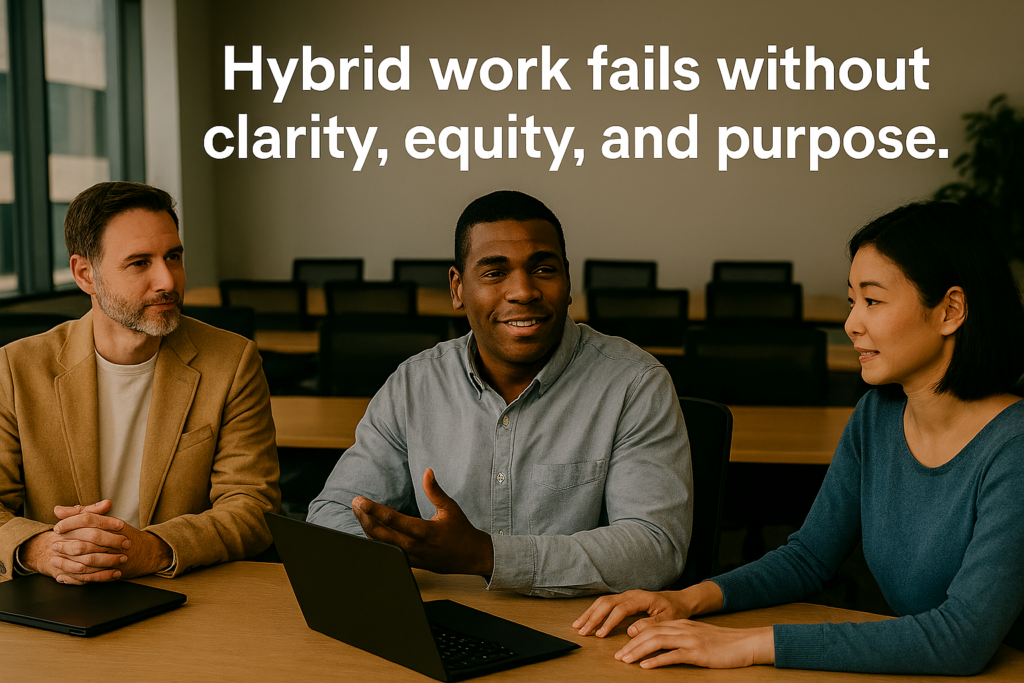
Hybrid work fails without clarity, equity, and purpose.
The problem isn’t where people work.
It’s whether the organization has defined how work should happen—and why.
Which leads to the next, unavoidable question:
👉 What is your hybrid work philosophy?
Because until an organization clearly defines its philosophy—its beliefs about presence, performance, collaboration, and trust—every hybrid policy will feel arbitrary.