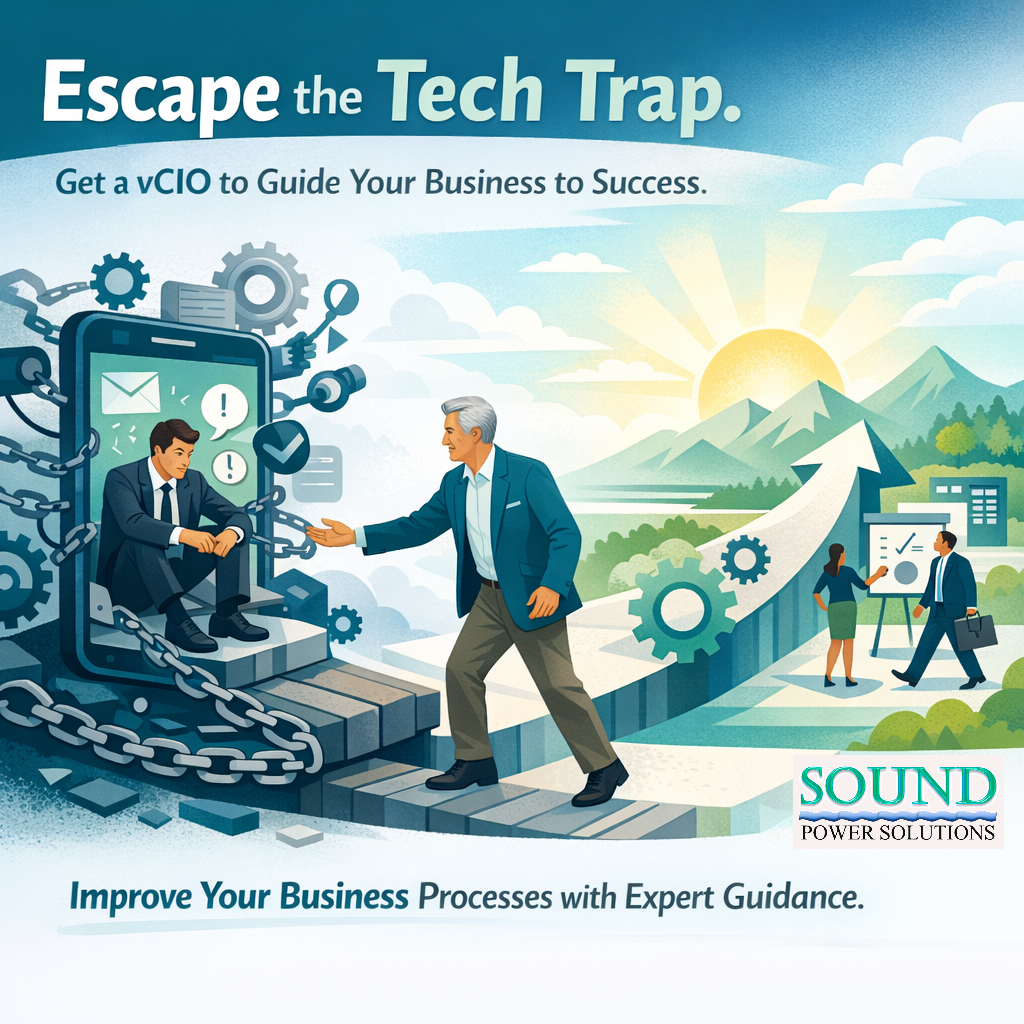
For many organizations, “IT strategy” has quietly become shorthand for something else entirely:
What systems do we upgrade next?
How do we move faster?
How do we do the same work cheaper?
While those questions feel practical, they often pull leadership into what we call the “how” trap—a narrow focus on technology execution rather than business impact. The result? Faster systems that power the same old problems, lower costs that don’t unlock growth, and transformation initiatives that stall before delivering real value.
If technology is meant to be a competitive advantage, we have to escape the how trap—and that starts by reframing IT strategy around business capabilities, not just tools.
The Problem With Doing the Same Things Better

Many technology roadmaps read like efficiency checklists:
- Migrate legacy servers to the cloud
- Upgrade ERP or CRM platforms
- Automate manual workflows
- Reduce infrastructure costs
None of these are inherently wrong. In fact, they’re often necessary. But when they become the strategy rather than enablers of it, organizations risk optimizing yesterday’s business model.
Doing the same things faster or cheaper does not automatically make the business more competitive. Nor does it automatically make the organization perform better. It just makes the current operating model more efficient—whether that model still serves the market or not.
The real question leadership should be asking is not “How do we implement better technology?”
It is “What must the business be able to do that it cannot do today?”
Start With Capabilities, Not Technology
Business capabilities describe what an organization must excel at to deliver value—independent of how those capabilities are implemented.
Examples might include:
- Delivering a fully digital customer onboarding experience
- Using real‑time data to inform pricing or inventory decisions
- Scaling operations without increasing headcount
- Supporting a hybrid or remote workforce securely
- Launching new products or services faster than competitors
These are not technology projects. They are business outcomes. Technology plays a critical role—but only as part of a broader system that includes people, processes, governance, and change management.
When IT strategy starts with capabilities, technology decisions become clearer, more defensible, and easier to prioritize.

The “How” Trap in Action
Organizations fall into the how trap when conversations jump straight to solutions:
- “We need a new CRM.”
- “Let’s move everything to the cloud.”
- “AI will fix this.”
Without first defining why the change matters and what capability it enables, technology becomes a maze of disconnected initiatives—each optimized locally, but misaligned globally.
This is why so many digital transformations feel expensive yet underwhelming. They focus on implementation mechanics instead of strategic intent.
Escaping the how trap requires discipline:
Pause the solutioning just long enough to align technology decisions to business direction.
The Role of a vCIO: Connecting Strategy to Execution
This is where a Virtual CIO (vCIO) adds outsized value.
A strong vCIO does not start by choosing tools. They start by asking structured, sometimes uncomfortable questions:
- What are the organization’s strategic goals over the next 12–36 months?
- Which business capabilities most directly support those goals?
- Where are current constraints—technology, skills, process, or structure?
- Which investments will create new value, not just marginal efficiency?
Only after this groundwork is laid does the conversation move into architecture, platforms, vendors, and budgets.
In effect, the vCIO acts as a translator—connecting executive intent to technical reality, and ensuring IT investments are made on purpose, not by habit.
From Technology Roadmaps to Capability Roadmaps
The shift from “how” to “what” transforms planning artifacts as well.
Traditional IT Roadmap:
- System upgrades
- Version timelines
- Infrastructure refresh cycles
Capability‑Driven Roadmap:
- Capabilities to enable or mature over time
- Business value tied to each investment
- Dependencies across people, process, and technology
- Measurable outcomes and success criteria
This approach gives leadership a far clearer view of why investments are being made—and what success should actually look like.
Escaping the Trap Is a Leadership Decision
Technology teams don’t fall into the how trap on their own. They’re often responding to leadership signals that reward speed, cost reduction, or tactical wins over long‑term value creation.
Escaping the how trap requires intentional leadership—leaders willing to slow down the solution conversation just enough to ensure the organization is building the right capabilities for the future.
Because in the end, technology should not just help you run the business better.
It should help you become a better business.